
The CRMA certification (Certification in Risk Management Assurance) validates an professional's ability to evaluate risk governance and internal control frameworks. However, modern risk strategies increasingly intersect with data privacy, where credentials like the CIPP certification (Certified Information Privacy Professional) become essential. While CRMA focuses on corporate auditing and risk assurance, earning a CIPP credential proves technical fluency in privacy laws, data governance, and regulatory compliance—making both certifications vital pillars for comprehensive organizational risk management in highly regulated sectors.
Understanding CRMA Certification and Its Privacy Intersection
Risk management assurance is no longer isolated to financial or operational audits. Modern governance requires risk leaders to evaluate compliance structures, legal exposure, and corporate liability. While the CRMA certification focuses on evaluating organizational risk management processes, the rapid proliferation of global data privacy mandates—such as GDPR, CCPA, and CPRA—has made data governance one of the largest corporate risk vectors today.
To bridge this gap, risk professionals frequently pair general risk assurance expertise with specialized privacy credentials like the CIPP certification exam. By understanding both general enterprise risk and legal privacy frameworks, risk officers can build resilient governance programs that withstand intense regulatory scrutiny.
CIPP Certification Concentrations: Regional Focus Areas
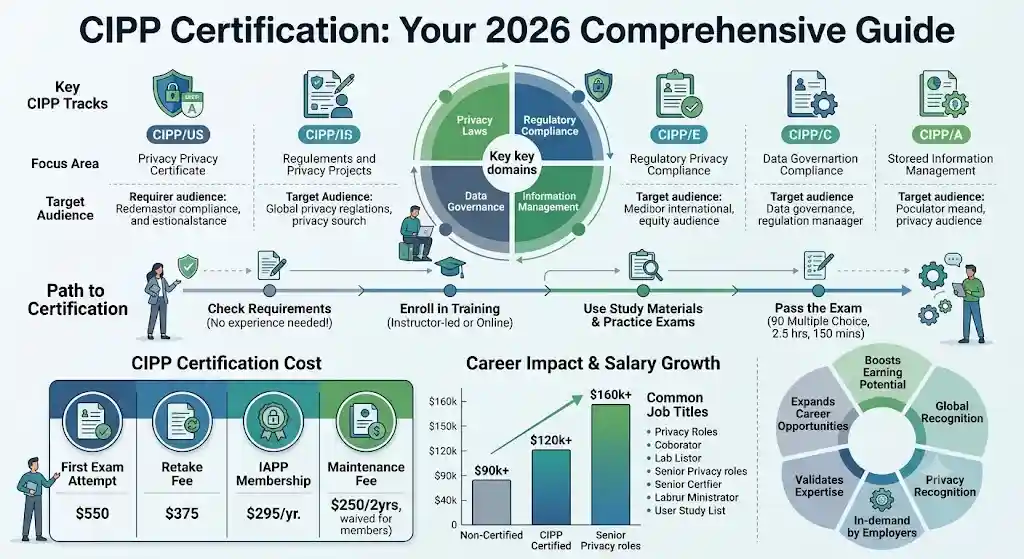
Unlike general risk certifications, privacy regulations are highly jurisdictional. The International Association of Privacy Professionals (IAPP) offers specialized tracks depending on where your organization operates:
| Certification Track | Regulatory Focus | Primary Target Audience |
|---|---|---|
| CIPP/US | U.S. Private-Sector Laws, State Privacy Laws, FCPA | U.S. risk officers, legal consultants, compliance managers |
| CIPP/E | European GDPR, ePrivacy Directive, Cross-Border Transfers | Data Protection Officers (DPOs), global privacy leads |
| CIPP/C | Canadian Federal (PIPEDA) & Provincial Privacy Acts | Canadian compliance specialists, corporate auditors |
| CIPP/A | Asia-Pacific Privacy Frameworks (Singapore, HK, India) | APAC risk analysts, international governance leaders |
Breakdown of CIPP Certification Cost and Investment
A core consideration when expanding your professional portfolio beyond a CRMA certification is evaluating the total financial investment. The standard CIPP certification cost breakdown includes exam fees, maintenance, and study resources:
First Exam Attempt: $550 USD across all major concentrations (CIPP/US, CIPP/E, CIPP/C, CIPP/A).
Retake Fee: $375 USD if an candidate needs to retake the exam within their eligibility window.
IAPP Annual Membership (Optional): $295/year, which waives the standalone maintenance fee and grants discounts on official training materials.
Certification Maintenance Fee (CMF): $250 every two years for non-members to maintain active status.
Many enterprise organizations fully reimburse these certification costs because specialized privacy expertise directly mitigates costly regulatory fines and compliance breaches.
CIPP Certification Requirements and Eligibility
A major benefit of pursuing IAPP credentials alongside or prior to a CRMA certification is accessibility:
Prerequisites: There are no mandatory prerequisites, formal educational degrees, or required years of prior experience to sit for the exam.
Recommended Background: Candidates benefit from foundational knowledge in legal risk, IT security governance, regulatory compliance, or enterprise risk management.
Target Professionals: Ideal for Risk Managers, Internal Auditors, Compliance Officers, Legal Counsel, DPOs, and IT Security Managers looking to validate their data protection knowledge.
Master the CIPP Certification Exam
The CIPP certification exam is designed to test scenario-based application rather than passive memorization.
Exam Structure
Questions: 90 multiple-# CRMA Certification: The Ultimate Guide to Exam Prep, Costs, and Career Growth
Answer Capsule: The CRMA certification (Certification in Risk Management Assurance), awarded by The Institute of Internal Auditors (IIA), validates an auditor's capability to evaluate, monitor, and manage organizational risk governance. Designed for internal auditors and risk specialists, passing the CRMA certification exam proves expertise in core risk management frameworks, assurance processes, and strategic risk advisory. Holding this credential elevates professional credibility, accelerates career progression into leadership roles like Chief Audit Executive (CAE), and significantly boosts lifetime earning potential across financial and corporate sectors.
What Is the CRMA Certification?
The Certification in Risk Management Assurance (CRMA) is an advanced professional designation granted by The Institute of Internal Auditors (IIA). While general auditing credentials demonstrate competence in standard financial and operational reviews, the CRMA certification focuses specifically on risk governance, enterprise risk management (ERM), and providing risk assurance to board-level audit committees.
As organizations navigate increasingly complex regulatory, technological, and geopolitical environments, the demand for auditors who can evaluate proactive risk management strategies rather than merely react to control failures has skyrocketed.
CRMA Certification vs. CIPP Certification: Choosing the Right Track
Risk management and data privacy frequently overlap in modern governance, risk, and compliance (GRC) frameworks. However, professionals often confuse enterprise risk certifications like the CRMA with data protection credentials like the CIPP certification exam.
The table below breaks down the structural differences between enterprise risk assurance and privacy compliance credentials to help you align your certification path with your career goals:
| Feature / Metric | CRMA Certification (IIA) | CIPP Certification (IAPP) |
|---|---|---|
| Primary Focus | Enterprise Risk Governance & Assurance | Data Protection Laws & Privacy Regulations |
| Governing Body | The Institute of Internal Auditors (IIA) | International Association of Privacy Professionals (IAPP) |
| Target Audience | Risk Analysts, Internal Auditors, CAEs | Privacy Officers, Legal Counsel, Compliance |
| Prerequisites | Active CIA designation + Risk/Audit experience | None (Open to all professionals) |
| Core Value Proposition | Strategic risk advisory & internal control evaluation | Legal compliance (GDPR, CCPA, cross-border data) |
| Related Credentials | CIA, CRMA | CIPP Certification Training (CIPP/US, CIPP/E) |
CRMA Certification Requirements & Eligibility
To qualify for the CRMA certification, candidates must satisfy strict criteria set by the IIA to ensure only experienced risk practitioners attain the credential.
Key Prerequisites:
Hold an Active CIA Designation: You must be an active Certified Internal Auditor (CIA) holder. The IIA updated its program structure to require the CIA as a prerequisite for the CRMA.
Professional Experience:
Minimum 2 to 5 years of internal audit or risk management assurance experience (depending on your highest level of education).
Professional Character Reference: A signature from a CIA, CGAP, CCSA, CRMA, or your supervisor attesting to your ethical standards.
Government-Issued ID: Proof of identity during registration.
Breaking Down the CRMA Exam Format & Core Domains
The CRMA exam is a computer-based, single-part examination administered globally via Pearson VUE test centers and online proctoring.
Exam Overview:
Questions: 120 multiple-choice questions
Time Allotted: 150 minutes (2.5 hours)
Scoring: Scaled scoring system ranging from 250 to 700 points; a score of 600 is required to pass.
Core Syllabus Domains:
Domain I: Organizational Governance Related to Risk Management (20%)
Evaluating risk management frameworks (e.g., COSO ERM, ISO 31000).
Assessing tone at the top and organizational risk culture.
Domain II: Principles of Risk Management Processes (30%)
Identifying risk appetite, risk tolerance, and key risk indicators (KRIs).
Evaluating risk identification, assessment, and response mechanisms.
Domain III: Assurance on Risk Management Processes (40%)
Formulating audit plans based on risk maturity.
Evaluating third-party risks, technology risks, and emerging operational threats.
Domain IV: Consulting Role in Risk Management (10%)
Advising management on risk framework design without impairing audit independence.
Total Investment: CRMA vs. CIPP Certification Costs
Budgeting for specialized credentials requires looking at exam fees, study resources, and ongoing maintenance. While the CIPP certification cost typically ranges from $550 for the exam fee plus $250 in annual membership dues, the CRMA credential follows the IIA’s structured fee table based on membership status.
Cost Breakdown:
IIA Application Fee:
IIA Members: ~$120 USD
Non-Members: ~$220 USD
CRMA Exam Registration Fee:
IIA Members: ~$495 USD
Non-Members: ~$680 USD
Preparation & Study Materials:
Official IIA CRMA Study Guide & Exam Prep: ~$150 – $300 USD
Third-party training courses or a CIPP certification study guide / CIPP certification online program (if dual-certifying in privacy risk): ~$400 – $1,200 USD
Step-by-Step Blueprint to Pass the CRMA Exam
Achieving a passing score on your first attempt requires a structured approach that moves beyond simple rote memorization.
[Step 1: Confirm Eligibility & CIA Status] │ ▼ [Step 2: Obtain Official IIA CRMA Study Syllabus] │ ▼ [Step 3: Complete 60-80 Hours of Targeted Study] │ ▼ [Step 4: Take Domain-Specific Practice Exams] │ ▼ [Step 5: Sit for the Pearson VUE CRMA Exam]
1. Master the COSO ERM and ISO 31000 Frameworks
The exam relies heavily on standard risk frameworks. You must understand how to apply COSO ERM concepts in real-world scenario questions rather than just memorizing definitions.
2. Leverage High-Quality Practice Questions
Utilize practice questions structured like official IIA questions. Similar to preparing with a CIPP certification practice exam or specialized audit practice questions, testing your knowledge under timed conditions highlights weak domains early.
3. Understand Audit Independence vs. Consulting
Many candidates lose points on Domain IV. Remember that while an auditor can advise management on risk frameworks, they must never take ownership of risk management decisions.
Career Impact and Salary Expectations
Earning the CRMA certification significantly boosts your professional marketability and earning power. Organizations actively seek professionals who can bridge the gap between technical internal auditing and executive risk strategy.
Average Salary Benchmarks:
Internal Risk Manager: $115,000 – $145,000 / year
Senior Risk Assurance Auditor: $105,000 – $130,000 / year
Director of Enterprise Risk / Chief Audit Executive: $160,000 – $220,000+ / year
(Note: Salary ranges vary based on geographic location, enterprise size, and dual certifications. For example, combining the CRMA with privacy credentials—where the average CIPP certification salary ranges between $120,000 and $160,000—positions you uniquely for Chief Risk & Privacy Officer roles.)
Next Steps for Risk & Governance Professionals
Earning your CRMA certification marks a transition from standard auditing to executive-level risk management assurance.
To get started today:
Verify your active CIA status on the IIA Certification Candidate Management System (CCMS).
Download the official CRMA Exam Syllabus to conduct a personal gap assessment.
Map out a 60-day study calendar focused heavily on COSO ERM implementation and governance assurance.