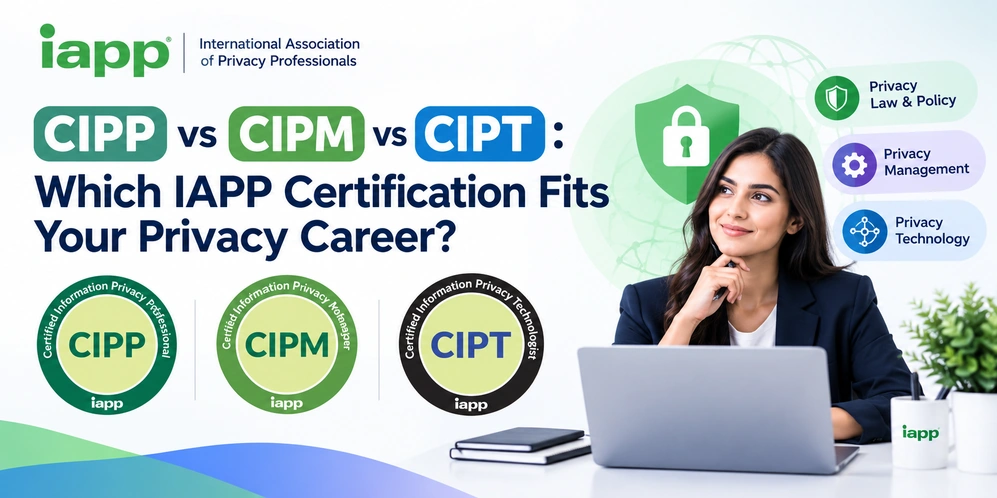
CIPP, CIPM, and CIPT are IAPP certifications for different areas of privacy work. CIPP focuses on privacy laws and regulatory frameworks; CIPM focuses on building and managing a privacy program; and CIPT focuses on applying privacy principles through technology. To choose among them, start with the work you do—or want to do—and compare it with each credential’s subject matter.
CIPP, CIPM, and CIPT at a glance
| Certification | Main focus | Common professional fit |
|---|---|---|
| CIPP | Privacy laws, regulations, and frameworks | Legal, compliance, data protection, and information management |
| CIPM | Privacy program administration and operations | Privacy program managers, risk professionals, auditors, and privacy operations teams |
| CIPT | Privacy in technology and product development | IT, information security, software engineering, and product teams |
The IAPP describes CIPP as a credential about privacy and data protection laws, CIPM as a credential for privacy program administration, and CIPT as a credential for integrating data protection into products and services. These are distinct areas of knowledge, although responsibilities can overlap in practice.
What is the CIPP certification?
The Certified Information Privacy Professional (CIPP) is the privacy law certification in this comparison. It is designed to demonstrate knowledge of privacy laws, regulations, and frameworks. CIPP includes jurisdiction-specific concentrations, so candidates should choose one that matches the legal environment most relevant to their work.
The IAPP currently presents CIPP options for Asia, Australia, Canada, China, Europe, and the United States. Examples include CIPP/E, which focuses on the EU General Data Protection Regulation and European national frameworks, and CIPP/US, which focuses on U.S. privacy laws and regulations. The IAPP’s CIPP page describes the credential’s regional focus and intended audiences.
CIPP may suit professionals who interpret privacy requirements, support compliance, advise teams on data protection obligations, or manage privacy matters connected to a particular jurisdiction. It may also be relevant to people in information management, data governance, and human resources when privacy requirements are part of their responsibilities.
When deciding between CIPP vs CIPM certification, consider whether your work centers on understanding and applying legal frameworks or on operating an organization’s privacy program. CIPP is the more direct fit for the first focus. It is not primarily a technical credential, and it does not focus on running a privacy program’s full operational life cycle.
What is the CIPM certification?
The Certified Information Privacy Manager (CIPM) focuses on establishing, maintaining, and managing a privacy program. The IAPP describes CIPM as a credential for professionals who lead privacy program administration and manage the program across its life cycle.
A privacy program helps an organization turn its obligations and policies into working processes. Depending on the organization, this can involve assigning responsibilities, coordinating with different teams, managing privacy risks, supporting accountability, and reviewing how privacy practices operate. These activities connect legal requirements to day-to-day business operations.
CIPM may fit privacy managers, privacy operations professionals, and people responsible for risk management, audits, accountability, or privacy analytics. It may also suit professionals who coordinate privacy work across legal, security, product, and business teams.
CIPM is a privacy program management certification, rather than a credential focused mainly on one jurisdiction’s laws. That is the main distinction between CIPP and CIPM. It also differs from CIPT: CIPM centers on program administration, while CIPT centers on technology and product development.
What is the CIPT certification?
The Certified Information Privacy Technologist (CIPT) focuses on the role of technology in protecting personal data. The IAPP describes CIPT as demonstrating the ability to use technical solutions to build data protection into products and services. Its stated focus includes privacy-friendly design, data protection throughout development, and practices such as data minimization, limited access, and encryption.
CIPT may suit IT professionals, information security specialists, software engineers, and others who help design or maintain systems that handle personal data. It is the most directly relevant option in this comparison for professionals who want to apply privacy by design in products, services, or technical processes.
CIPT is a privacy technology certification, not a software development credential. Its focus is the connection between privacy and technology decisions. A candidate whose responsibilities are mostly legal interpretation may find CIPP more relevant; someone accountable for an organization-wide privacy program may find CIPM more aligned with their work.
Difference between CIPP, CIPM, and CIPT
The difference between CIPP, CIPM, and CIPT is the kind of privacy responsibility each one addresses:
- CIPP: Which privacy laws and regulatory frameworks apply?
- CIPM: How should an organization establish and manage its privacy program?
- CIPT: How can technology and product design support data protection?
The three credentials can complement one another. A privacy program manager may need to understand the laws that shape the program. A software engineer may need to understand both internal privacy processes and technical safeguards. However, their subject matter is not interchangeable. Choose based on the knowledge most directly connected to your responsibilities.
Which IAPP certification should you get?
Use your current work as a practical starting point for choosing an IAPP privacy certification.
| If your work mainly involves… | Consider… | Because it focuses on… |
|---|---|---|
| Interpreting privacy laws or supporting regulatory compliance | CIPP | Laws and frameworks for a selected jurisdiction |
| Establishing or coordinating privacy processes | CIPM | Privacy program administration |
| Designing, securing, or maintaining products and systems | CIPT | Applying privacy principles through technology |
| Both legal requirements and program operations | CIPP or CIPM | Choose according to whether law or program management is your main focus |
| Both technology and privacy controls | CIPT | Connecting data protection with technical design and implementation |
This comparison is guidance, not a rule about which credential guarantees a particular career outcome. A compliance professional may find CIPP relevant when interpreting legal requirements, or CIPM relevant when coordinating a privacy program. Similarly, an IT professional may find CIPT useful when technical decisions affect personal data. The best IAPP certification for privacy professionals depends on their actual responsibilities and learning goals.
For another certification comparison, read our CRMA vs. CIPP certification guide. It discusses how a privacy credential and an internal audit and risk credential differ in focus.
Which IAPP certification should you take first?
There is no single required order for CIPP, CIPM, and CIPT. Start with the credential that most closely matches the work you do now or the responsibilities you want to develop.
If you work with privacy laws in a particular region, consider the relevant CIPP concentration. If you are responsible for putting privacy requirements into organizational processes, consider CIPM. If your role involves technical design, information security, or product development, consider CIPT.
Some professionals may later pursue additional credentials as their responsibilities expand. For example, someone who manages a privacy program may decide to deepen their knowledge of a jurisdiction’s laws. A technologist may pursue program management knowledge if their work grows to include privacy operations. Before choosing a second credential, identify the knowledge gap it would address.
Exam and preparation considerations
The IAPP’s current certification FAQ lists 90 questions and a 2.5-hour exam length for the CIPP exams shown in its table, CIPM, and CIPT. It also says that exams include multiple-choice questions, some scenario-based questions, and clearly labeled multi-select questions. The CIPP/Australia exam is not listed in that table, so confirm its current format on the relevant IAPP page before planning.
For preparation, the IAPP recommends planning for at least 30 hours of study. Begin with the credential’s Body of Knowledge and Exam Blueprint, which outline the subject areas and exam structure. The IAPP certification pages also provide study resources, including downloadable guides; available tools vary by credential.
Make your study plan specific to the credential. For CIPP, focus on the selected jurisdiction’s privacy framework. For CIPM, organize your review around privacy program responsibilities and operations. For CIPT, connect privacy concepts to technical design and data protection practices.
Frequently asked questions
Is CIPP, CIPM, or CIPT best for beginners?
There is no single best option for every beginner. Choose the credential whose focus is closest to your work or learning goal: laws and frameworks for CIPP, program operations for CIPM, or technology for CIPT.
Is CIPP focused on a specific region?
CIPP has jurisdiction-specific concentrations. Select the one that matches the privacy laws and frameworks most relevant to your professional context. Check the current IAPP page for the available options.
Is CIPT only for software engineers?
No. The IAPP identifies technology and data professionals as relevant audiences. IT and information security professionals may also find CIPT applicable when their work affects data protection in products or services.
Can I earn more than one IAPP certification?
Yes. The certifications address different areas of privacy knowledge, so professionals may pursue more than one when their responsibilities span legal, operational, or technical work. Choose each credential for a clear learning need.
Which certification focuses on privacy by design?
CIPT is the most directly focused on applying privacy within technology, products, and services.
Ready to Start Your ISACA Certification Journey?
Contact our team for ISACA certification online training, study resources, practice questions, and exam preparation support.
Contact UsChoose by your privacy responsibilities
CIPP, CIPM, and CIPT each address a different part of privacy practice: understanding laws, managing a program, or applying privacy through technology. Compare your responsibilities with the official Body of Knowledge for the credential you are considering, and confirm current exam details before you prepare. For official certification information, visit the IAPP website.