
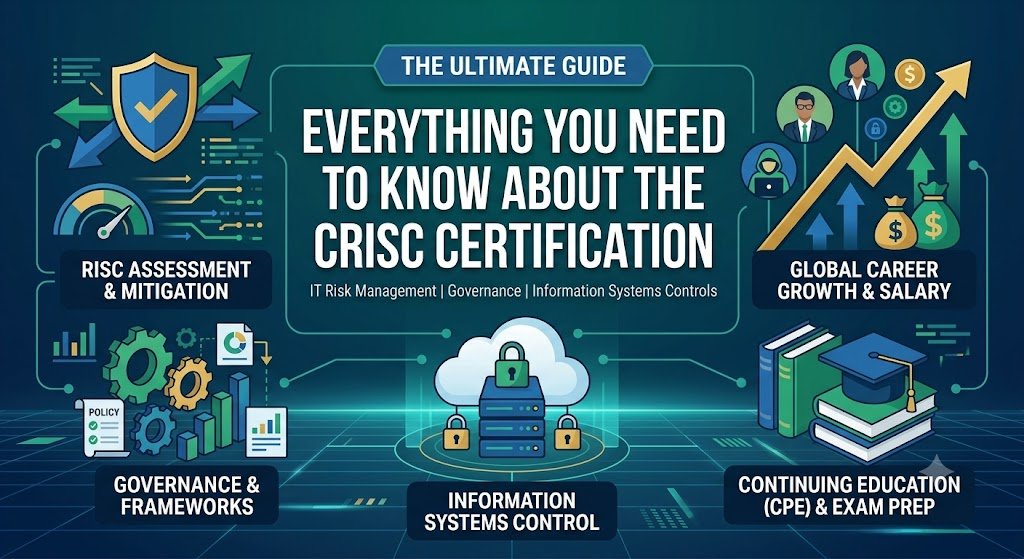
The CRISC Certification (Certified in Risk and Information Systems Control) by ISACA is the premier credential for IT risk management professionals. It validates your ability to identify, evaluate, and mitigate enterprise IT risk while designing robust information systems controls. Earning this certification requires passing a 150-question scenario-based exam, verifying three years of relevant work experience across required domains, and adhering to ISACA's professional ethics. With an average salary exceeding $145,000, CRISC equips practitioners to bridge IT risk with business strategy.
Strategic Value of the CRISC Certification in Modern Enterprise
Enterprise IT environments face unprecedented operational pressures, ranging from complex multi-cloud migrations and third-party vendor dependencies to evolving cyber threats. Technical security alone is no longer enough to safeguard business operations; organizations demand leaders who can quantifiably assess risk and align security controls with broader corporate strategy.
Earning a specialized IT risk management certification signals to executive leadership that you understand how operational vulnerabilities translate into financial and strategic business impacts. Whether you are leading a GRC team, auditing critical infrastructure, or seeking specialized training like the CRISC certification in New York, holding this designation positions you as a high-value asset capable of defending the risk register at the boardroom level.
Breakdown of the CRISC Exam Domains
The exam is designed to test practical, real-world scenario execution rather than theoretical memorization. ISACA continually updates the Job Practice areas to match the current technology landscape. Candidates face 150 multiple-choice questions over a 4-hour window, evaluated on a scaled passing threshold of 450 out of 800.
| Domain | Core Focus | Exam Weight | Key Tasks & Knowledge Areas |
|---|---|---|---|
| Domain 1 | Governance | 26% | Organizational governance structure, IT risk appetite, risk tolerance, and enterprise strategy alignment. |
| Domain 2 | Risk Assessment | 22% | Vulnerability identification, threat analysis, qualitative/quantitative risk modeling (ALE, SLE, ARO). |
| Domain 3 | Risk Response & Reporting | 32% | Risk treatment plans, risk response option selection, control design, and key risk indicators (KRIs). |
| Domain 4 | Technology & Security | 20% | Information systems control design, implementation, testing, continuous monitoring, and security architecture. |
Mastering the CRISC exam domains requires an understanding of how these four pillars interconnect. Domain 3 carries the largest weight, emphasizing that identifying a risk is useless unless you can formulate, execute, and monitor an effective risk response plan.
Understanding CRISC Certification Requirements
Sitting for the exam and claiming the title are two separate processes. ISACA allows professionals to take the exam at any point in their career, but full credentialing is granted only after satisfying all CRISC certification requirements:
Pass the CRISC Exam: Secure a scaled score of 450 or higher on the official 150-question computer-based exam.
Verify Work Experience: Document three (3) years of cumulative work experience performing tasks across at least two CRISC domains. At least one of those domains must be Domain 1 (Governance) or Domain 3 (Risk Response and Reporting).
Experience Application Window: Submit your verified experience within 5 years of passing the exam. Qualifying experience must be earned within the 10 years prior to application or within 5 years after passing.
Ethics Compliance: Formally agree to abide by the ISACA Code of Professional Ethics.
Unlike certain entry-level options, ISACA does not allow academic degree waivers or substitutions for the three-year work experience rule, ensuring every credential holder possesses proven field experience.
Financial Blueprint: ISACA CRISC Exam Cost
Budgeting for your credential requires taking into account both initial testing fees and administrative processing costs. Becoming an ISACA member prior to exam registration offers significant cost benefits.
ISACA Member Exam Fee: $575
Non-Member Exam Fee: $760
Application Processing Fee: $50 (paid upon passing when submitting experience verification)
Annual ISACA Membership Fee: $135 (plus a one-time $50 new member processing fee)
For complete registration schedules and test center availability, refer directly to the official ISACA CRISC portal.
Career ROI: CRISC Salary Expectations
Investing time and financial resources into this credential delivers measurable returns. Industry surveys consistently rank CRISC among the top-paying certifications in cybersecurity and governance, risk, and compliance (GRC).
Market data shows strong CRISC salary expectations across various GRC leadership roles:
IT Risk Manager / Risk Analyst: $125,000 – $145,000
Information Security Manager / Director: $145,000 – $175,000
Director of Governance, Risk, and Compliance (GRC): $160,000 – $190,000
Chief Information Security Officer (CISO) / Chief Risk Officer (CRO): $190,000+
Because the certification bridges technical controls with business risk, professionals holding CRISC often secure promotions to strategic managerial roles faster than purely technical peers.
Maintaining Active Status: CRISC Continuing Professional Education (CPE)
Obtaining your credential is a continuous commitment. To keep your certification active and stay aligned with evolving frameworks, you must adhere to the CRISC continuing professional education (CPE) policy.
Annual Minimum: Earn and report at least 20 CPE hours each calendar year.
Three-Year Cycle Requirement: Accumulate a total of 120 CPE hours over every three-year reporting cycle.
Annual Maintenance Fee: Pay $45 (ISACA Members) or $85 (Non-Members).
Valid CPE activities include attending risk management conferences, completing vendor-neutral technical courses, publishing industry research, or participating in regional ISACA chapter activities.
Actionable Next Steps to Build Your Preparation Strategy
To optimize your preparation and pass on your first attempt:
Review the Job Practice Outline: Map your daily professional duties against the four official domains to identify knowledge gaps early.
Focus on the "ISACA Mindset": Approach questions from the perspective of an enterprise risk executive who prioritizes business objectives, governance frameworks, and cost-effective risk mitigation.
Establish a 12-Week Study Plan: Allocate 8–10 hours per week utilizing official review manuals and practice question databases before scheduling your exam.