The IAP certification is The Institute of Internal Auditors’ Internal Audit Practitioner designation. It is an entry-level credential for university students, beginner internal auditors, rotational auditors, managers of internal audit activities, and professionals without a degree. No education or work experience is required. Applicants submit an application and government-issued photo ID through CCMS, then take a 125-question multiple-choice exam in 150 minutes. An active IAP can waive CIA Part 1, although CIA experience requirements still apply. Confirm current fees, policies, exam availability, and renewal rules before registering and choose preparation resources aligned with the official syllabus and current exam objectives.
What Is IAP Certification?
IAP stands for Internal Audit Practitioner. It is The IIA’s entry-level professional designation for foundational internal audit knowledge, not a degree, government licence, or generic certificate course.
The IAP validates understanding of internal auditing and the Global Internal Audit Standards. Applicants do not need a bachelor’s degree or previous internal audit experience, making the qualification useful for students and early-career professionals.
An active IAP supports progression to the Certified Internal Auditor program and can waive CIA Part 1, but full CIA experience requirements still apply. The designation is permanent; active status requires 20 hours of CPE and annual renewal beginning in 2026.
Why Does IAP Certification Matter?
Internal audit work depends on risk awareness, control evaluation, governance, ethics, and clear reporting. The IAP gives beginners evidence of that foundation.
Key Benefits of IAP Certification
The main benefits of the Internal Audit Practitioner designation include:
- Accessible entry requirements without a degree or work experience.
- A professional credential issued by The IIA.
- Foundational knowledge of the Global Internal Audit Standards.
- One exam rather than the three-part CIA examination.
- A potential CIA Part 1 waiver while the IAP is active.
- Stronger positioning for junior internal audit, risk, and compliance roles.
The credential does not guarantee employment or promotion. Its value increases when you connect the knowledge to practical work such as documenting processes, evaluating controls, and communicating findings.
Who Should Pursue IAP Certification?
The IAP program is suitable for:
- University students preparing for an internal audit career.
- Beginner, rotational, and new internal auditors.
- Managers responsible for internal audit activities.
- Professionals without a degree who want to validate foundational knowledge.
- Employees in accounting, finance, compliance, governance, operations, or quality.
Experienced audit leaders may prefer to pursue an advanced credential directly.
IAP Certification Requirements
The IAP certification requirements are limited. The IIA requires a completed application and government-issued photo ID. Education and professional experience are not required.
The practical IAP requirements are:
- Create or access a Certification Candidate Management System, or CCMS, account.
- Select the program, submit identification, and pay the application fee.
- Wait for approval before registering for the exam.
- Pass the exam within the permitted completion period.
After payment, applicants have 90 days to complete the application process. Once approved, candidates have two years to finish the program. Country rules, taxes, and testing arrangements may vary.
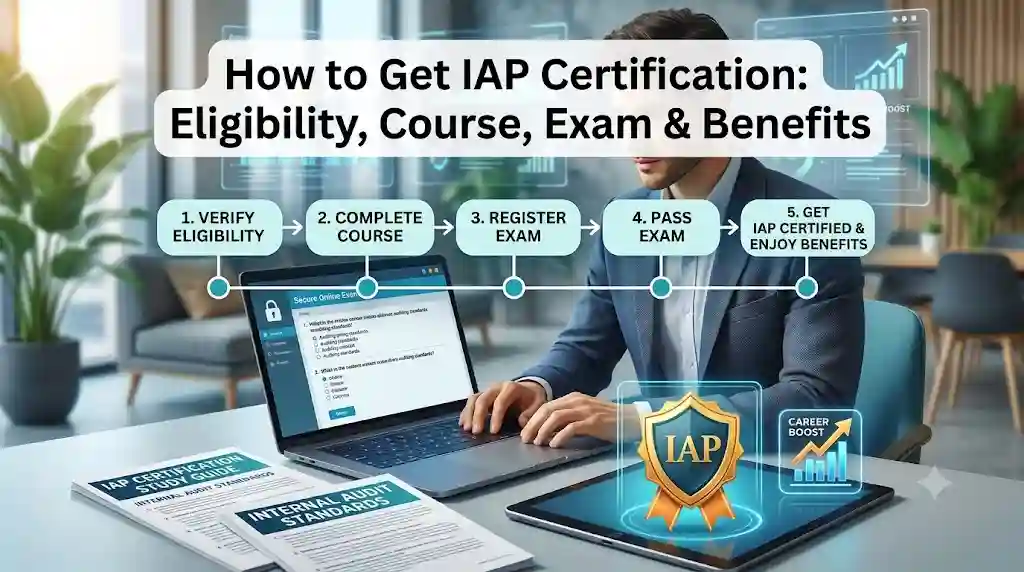
How to Get IAP Certification
The IAP registration process is completed in a defined sequence.
Step 1: Confirm your career goal
Review the exam level, CIA connection, renewal obligation, and target roles.
Step 2: Complete IAP registration online
Create or sign in to CCMS and upload a valid government-issued photo ID. Use your legal name consistently.
Step 3: Submit the application
Choose the program, check the order, and pay the application fee. Approval is required before exam registration. Track the application through CCMS and official IIA messages; an informal IAP registration number does not replace approval.
Step 4: Register and schedule the exam
After approval, open “Manage Program” in CCMS, register for the exam, and schedule an appointment.
Step 5: Receive the IAP certificate
After passing, The IIA posts the designation to your account. You can access a digital IAP certificate and opt into the Certification Registry for employer verification.
IAP Certification Course Options
The IAP is an exam-based designation, so an IAP certification course is optional preparation. A useful course should combine concepts, examples, and practice.
Look for coverage of:
- Internal audit purpose, responsibilities, and ethics.
- Governance, risk management, and internal controls.
- The Global Internal Audit Standards.
- Assurance, evidence, reporting, and scenario-based judgment.
Avoid providers offering leaked questions or claiming to issue an official IAP certificate before you pass The IIA examination.
IAP Certification Training: Online vs Classroom
Online IAP training suits working professionals who need flexible study and digital practice. Classroom training can work better for candidates who prefer fixed schedules and live discussion.
Compare instructor experience, syllabus alignment, question quality, revision support, and material currency. Effective training explains the reasoning behind answers.
What to Expect in the IAP Certification Exam
The IAP exam contains 125 multiple-choice questions and allows 150 minutes, or 2.5 hours. It tests foundational internal audit knowledge and application.
Prepare for ethics, governance, risk, controls, responsibilities, and workplace scenarios. The IAP is sometimes called an IAP board exam or IAP licensure exam, but it is a professional certification examination, not a government licensing test.
The IIA provides an IAP Guidebook and retired CIA Part 1 practice questions. An IAP review program is useful when it includes explanations, timed practice, and weak-area analysis.
IAP Certification Cost
The IAP certification cost varies by membership status, student status, country, taxes, and National Institute. The IIA currently lists these U.S. dollar prices for the United States, Canada, and selected countries:
- Application: $120 for members, $240 for non-members, and $45 for students.
- Exam: $310 for members, $445 for non-members, and $165 for students.
Fees are non-refundable and non-transferable. IAP membership fees are separate, and membership is required in some countries. Outside North America, confirm local pricing and taxes with the relevant National Institute.
Tips for Passing the IAP Certification Exam
Use a study plan that builds understanding before speed:
- Read the official syllabus and candidate guidance.
- Study the Global Internal Audit Standards and key terms.
- Use the IAP Guidebook and review every practice-question rationale.
- Keep an error log for recurring weaknesses.
- Practise workplace scenarios and take timed sessions.
- Confirm identification and testing instructions before exam day.
Consistent practice is more useful than last-minute memorisation.
Career Opportunities After Becoming an IAP Certified Professional
The IAP can support applications for junior internal auditor, audit associate, controls analyst, risk analyst, compliance analyst, and governance support roles.
Use the official name, Internal Audit Practitioner. IAPE certification, IIAP certification, and IAP licence are not correct names for this credential.
Is IAP Certification Worth It?
For students, entry-level candidates, and professionals without a degree, the IAP can be worthwhile because it offers accessible requirements, a defined exam target, and a route toward the CIA. It does not replace experience.
Before enrolling, compare the current price, preparation time, renewal obligations, and target jobs. A sensible path is IAP foundation, practical experience, then CIA or another advanced credential.
IAP Terminology and Common Search Confusions
IAP meaning, “what does IAP mean,” “what is an IAP,” and “IAP stands for” all refer to Internal Audit Practitioner here. “AIP application,” “how to get AP certified,” “IAP stand for,” “IAPE certification,” and “IIAP certification” are search variations, not separate IIA credentials.
IAP protocol usually refers to Google Cloud Identity-Aware Proxy, while a file extension is unrelated. IAP Career College and IAPCC accreditation are separate topics. The correct route is The IIA’s IAP page and CCMS.
Frequently Asked Questions
What is IAP Certification?
It is The IIA’s entry-level Internal Audit Practitioner designation, awarded after an approved application, a passing exam, and completion of program requirements.
Is IAP accreditation required?
No separate accreditation is required from a candidate. You must meet The IIA’s application, examination, and renewal rules. A course provider’s claim does not grant the designation.
Is an IAP review program mandatory?
No. IAP training and review programs are optional. Candidates may study independently with official guidance and practice resources.
Does the IAP designation expire?
The designation is permanent, but active status requires 20 hours of CPE and annual renewal beginning in 2026.
Is there an IAP list or public registration number?
The IIA Certification Registry can help employers verify active credentials when a holder opts in. Use CCMS records rather than an informal IAP list or public registration details.
What should I do next?
Review the current Internal Audit Practitioner information on The IIA’s official website, confirm your country’s rules, and create a study plan aligned with the official syllabus.
Ready to Start Your IAP Challenge Certification Journey?
Contact our team for IAP certification online training, study resources, practice questions, and exam preparation support.
Contact UsLearn More and Take the Next Step
The IAP is a practical starting point for internal audit. Confirm eligibility, apply through CCMS, prepare with reliable resources, and maintain the designation through CPE. Then decide whether the CIA fits your goals.