
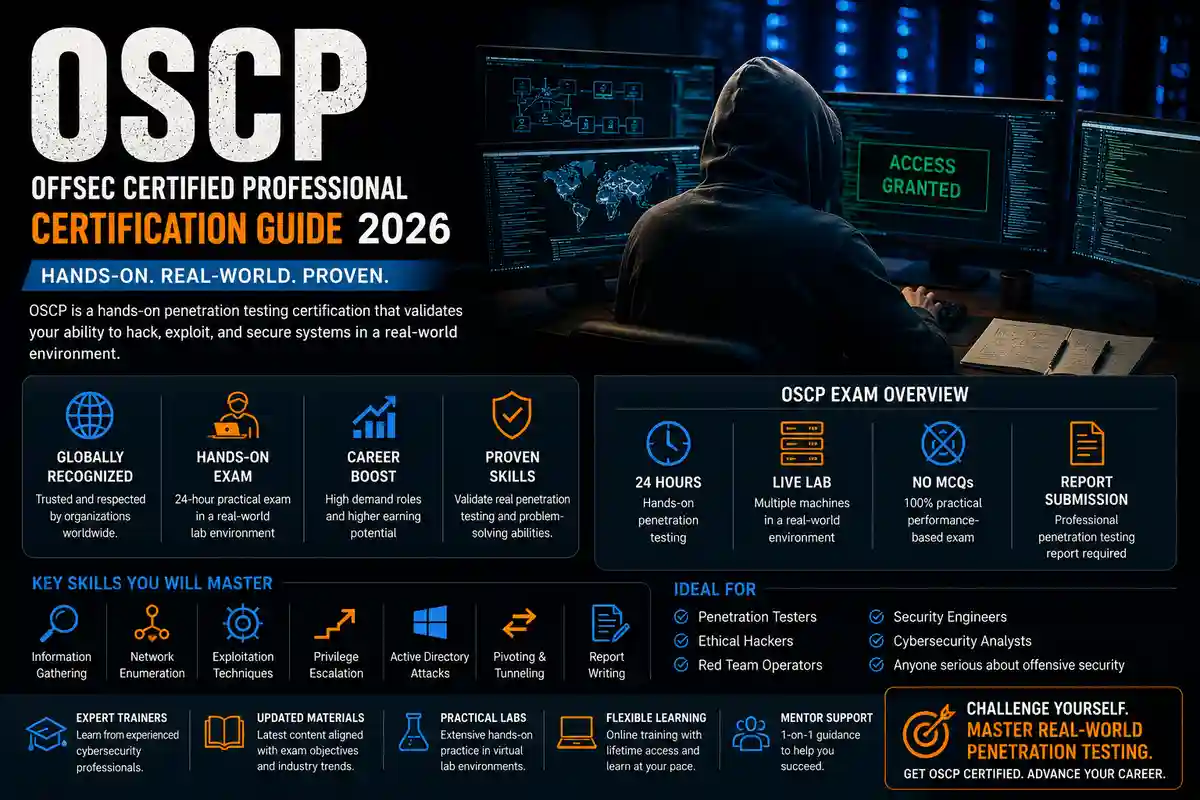
As cyber threats continue to evolve in complexity, organizations are increasingly seeking cybersecurity professionals who can identify and exploit vulnerabilities before malicious attackers do. While many cybersecurity certifications focus on theoretical knowledge through multiple-choice examinations, the OffSec Certified Professional (OSCP) certification stands apart by validating real-world penetration testing skills in a hands-on environment.
Offered by Offensive Security (OffSec), OSCP is recognized worldwide as one of the most respected ethical hacking certifications. It demonstrates that certified professionals possess the practical expertise needed to perform penetration testing engagements, assess enterprise security, and provide actionable recommendations to improve organizational defenses.
Whether you're an aspiring penetration tester, ethical hacker, security consultant, or red team operator, earning the OSCP certification can significantly enhance your credibility and open doors to exciting cybersecurity career opportunities.
What is OSCP Certification?
The OffSec Certified Professional (OSCP) is an advanced cybersecurity certification offered by Offensive Security (OffSec). It validates a candidate's ability to perform real-world penetration testing using industry-standard tools and methodologies.
Unlike certifications that primarily evaluate theoretical understanding, OSCP requires candidates to demonstrate practical skills by identifying vulnerabilities, exploiting target systems, escalating privileges, pivoting across networks, and documenting their findings in a professional penetration testing report.
Because of its emphasis on real-world scenarios, OSCP has become one of the industry's most respected certifications for offensive security professionals.
How OSCP Differs from Traditional Cybersecurity Certifications
One of the primary reasons OSCP is so highly respected is its unique examination approach.
Many cybersecurity certifications rely on multiple-choice questions that test theoretical concepts. OSCP, however, evaluates candidates through a live penetration testing environment where they must successfully compromise vulnerable machines.
Key differences include:
- Practical, hands-on examination
- Real-world penetration testing scenarios
- No multiple-choice questions
- Report writing based on actual findings
- Focus on methodology rather than memorization
- Demonstration of technical problem-solving skills
This practical format ensures that OSCP-certified professionals can apply their knowledge effectively in real-world environments.
Why Choose OSCP Certification?
OSCP offers numerous advantages for cybersecurity professionals looking to build careers in offensive security.
Global Recognition
OSCP is recognized by government agencies, multinational corporations, financial institutions, consulting firms, and cybersecurity organizations worldwide.
Hands-on Skill Validation
Employers value OSCP because it verifies practical penetration testing abilities rather than theoretical knowledge.
Career Advancement
The certification significantly strengthens resumes and increases opportunities for advanced cybersecurity positions.
Higher Earning Potential
Professionals with proven offensive security expertise often command competitive salaries and have access to premium consulting opportunities.
Continuous Learning
Preparing for OSCP develops deep technical knowledge that remains valuable throughout a cybersecurity career.
Who Should Pursue OSCP?
OSCP is ideal for professionals who want to specialize in offensive cybersecurity.
Recommended candidates include:
- Penetration Testers
- Ethical Hackers
- Security Analysts
- Cybersecurity Engineers
- Red Team Operators
- Security Consultants
- Network Security Engineers
- SOC Analysts
- Incident Response Professionals
- IT Professionals transitioning into cybersecurity
Recommended Prerequisites
Although there are no mandatory prerequisites, candidates should have a solid understanding of:
- TCP/IP Networking
- Linux Administration
- Windows Administration
- Bash Scripting
- Python Programming
- Basic Web Security
- Cybersecurity Fundamentals
- Networking Protocols
- Virtual Machines
Having experience with Capture the Flag (CTF) challenges and penetration testing labs is highly recommended before attempting OSCP.
PEN-200 Training Course
The OSCP certification is based on PEN-200: Penetration Testing with Kali Linux, OffSec's flagship training course.
The course combines theory with extensive laboratory exercises designed to simulate real enterprise environments.
Topics Covered
- Information Gathering
- Reconnaissance
- Enumeration
- Vulnerability Assessment
- Exploitation Techniques
- Web Application Security
- Active Directory Attacks
- Password Attacks
- Buffer Overflow Fundamentals
- Linux Privilege Escalation
- Windows Privilege Escalation
- Pivoting and Tunneling
- Post Exploitation
- Report Writing
Students gain access to hands-on labs where they can practice attacking vulnerable systems using industry-standard penetration testing techniques.
OSCP Exam Overview
The OSCP examination is one of the most challenging certification exams in cybersecurity.
| Feature | Details |
|---|---|
| Certification | OffSec Certified Professional (OSCP) |
| Training Course | PEN-200 |
| Exam Type | Practical Hands-on Lab |
| Duration | 24 Hours |
| Report Submission | Required |
| Question Format | No Multiple Choice |
| Assessment | Live Penetration Testing |
During the exam, candidates are required to compromise multiple machines within a controlled lab environment by applying real penetration testing methodologies.
After completing the practical assessment, candidates must submit a detailed professional penetration testing report documenting:
- Methodology
- Findings
- Screenshots
- Exploitation Steps
- Privilege Escalation
- Recommendations
The report is a critical component of the certification process and demonstrates the candidate's ability to communicate technical findings professionally.
Skills You Will Learn
Preparing for OSCP develops a wide range of practical cybersecurity skills.
These include:
- Network Enumeration
- Service Enumeration
- Vulnerability Identification
- Exploit Research
- Web Application Testing
- Linux Privilege Escalation
- Windows Privilege Escalation
- Active Directory Exploitation
- Password Cracking
- Credential Attacks
- Pivoting Between Networks
- Tunneling Techniques
- Lateral Movement
- Post Exploitation
- Report Writing
- Time Management During Engagements
These are the same skills used daily by professional penetration testers and red team operators.
Career Opportunities After OSCP
Earning the OSCP certification opens opportunities across numerous cybersecurity domains.
Common job roles include:
- Penetration Tester
- Ethical Hacker
- Red Team Operator
- Security Consultant
- Cybersecurity Engineer
- Application Security Engineer
- Vulnerability Assessment Specialist
- Security Researcher
- Network Security Engineer
- Incident Response Analyst
Many organizations specifically list OSCP as a preferred or desired qualification when hiring offensive security professionals.
Salary Prospects
OSCP-certified professionals often earn above-average salaries due to the practical nature of the certification.
Compensation depends on:
- Years of experience
- Technical expertise
- Country
- Industry
- Employer
- Additional certifications
Professionals working in consulting firms, financial institutions, cloud providers, government organizations, and cybersecurity companies frequently receive attractive compensation packages.
How to Prepare for OSCP Successfully
Success in OSCP depends more on consistent practice than memorization.
Recommended preparation strategies include:
Master the PEN-200 Course
Complete every module carefully and understand the methodology behind each attack.
Practice Regularly
Spend time working in penetration testing labs to strengthen practical skills.
Build Strong Foundations
Develop confidence in networking, Linux, Windows, scripting, and web technologies.
Learn Privilege Escalation
Privilege escalation is a key component of the OSCP exam and should receive significant attention.
Practice Active Directory
Modern enterprise environments rely heavily on Active Directory, making these skills increasingly valuable.
Improve Report Writing
A well-written penetration testing report is essential for passing the certification.
Solve Capture the Flag Challenges
Platforms offering CTF exercises help improve problem-solving abilities under time constraints.
Develop Time Management
The 24-hour practical exam requires efficient planning and execution.
Why Choose NYTCC for OSCP Preparation?
Preparing independently can be challenging, especially for candidates new to penetration testing.
NYTCC offers structured OSCP preparation designed to improve confidence and maximize success.
Benefits of NYTCC Training
- Experienced Cybersecurity Trainers
- Updated Study Materials
- Practical Lab Guidance
- Mock Penetration Testing Exercises
- One-on-One Mentoring
- Flexible Online Learning
- Exam Preparation Strategies
- Personalized Learning Support
With expert guidance and structured learning, candidates can strengthen both technical knowledge and practical penetration testing skills.
Frequently Asked Questions
Is OSCP difficult?
Yes. OSCP is widely regarded as one of the most challenging cybersecurity certifications because it requires candidates to solve practical penetration testing problems rather than answer multiple-choice questions.
Can beginners take OSCP?
Yes, but beginners should first build a strong foundation in networking, operating systems, scripting, and cybersecurity fundamentals before attempting the certification.
Is OSCP worth it?
Absolutely. OSCP is one of the most respected offensive security certifications and is highly valued by employers seeking professionals with proven practical skills.
How long does it take to prepare?
Preparation time varies depending on prior experience. Many candidates spend several months studying the PEN-200 material, practicing in labs, and completing Capture the Flag exercises before scheduling the exam.
Why OSCP Is Increasingly in Demand
As organizations adopt cloud technologies, hybrid infrastructures, and remote work environments, cyber threats continue to grow in sophistication. Employers need professionals who can proactively identify and remediate vulnerabilities before attackers exploit them.
OSCP-certified professionals are highly sought after because they demonstrate the ability to think like attackers, conduct realistic security assessments, and provide practical recommendations that strengthen organizational security.
The certification is valued across industries including:
- Financial Services
- Healthcare
- Government
- Defense
- Cloud Computing
- Technology
- Telecommunications
- Managed Security Service Providers (MSSPs)
Its practical focus makes OSCP one of the most relevant certifications for today's cybersecurity workforce.
Conclusion
The OffSec Certified Professional (OSCP) certification is more than just a credential—it is proof of practical expertise in penetration testing and offensive cybersecurity. Its hands-on examination, real-world scenarios, and emphasis on technical problem-solving make it one of the most respected certifications in the industry.
Whether your goal is to become an ethical hacker, penetration tester, security consultant, or red team specialist, OSCP equips you with the knowledge, confidence, and practical skills needed to succeed in today's cybersecurity landscape.
With dedicated preparation, consistent hands-on practice, and expert guidance from NYTCC, you can successfully earn the OSCP certification and take a significant step toward building a rewarding career in offensive security.