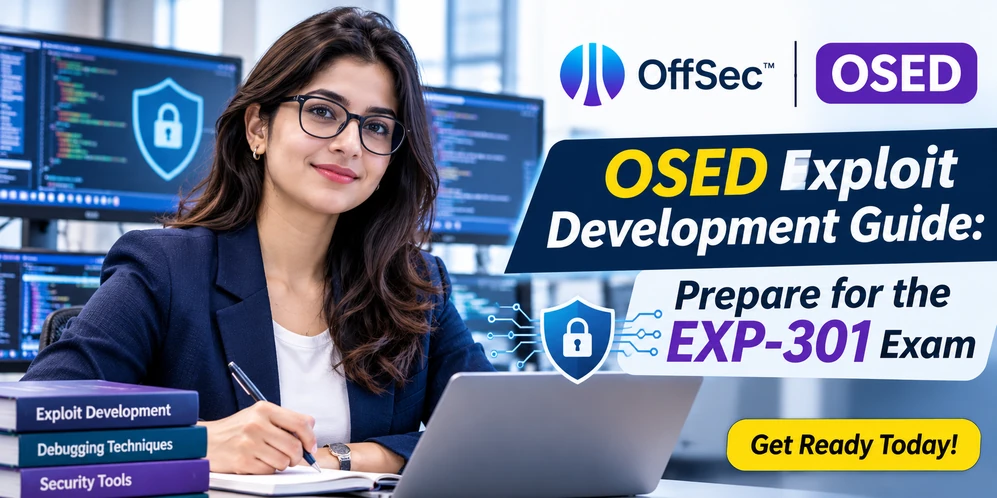
The OSED certification is for security professionals who want to demonstrate practical Windows user-mode exploit development skills. Earning it requires more than memorizing techniques: you need to reverse engineer vulnerable programs, build working exploits, work within exam tool restrictions, and document your process clearly.
This OSED exploit development guide explains what EXP-301 covers, the skills to build before starting, how the exam works, and how to structure your preparation. The exam and course details below are based on current information from OffSec.
What is the OSED certification?
OSED stands for OffSec Exploit Developer. The certification is associated with EXP-301: Windows User Mode Exploit Development, an intermediate-level course focused on finding vulnerabilities in Windows binaries and developing exploits in a controlled environment. OffSec describes the course as hands-on, with course modules, labs, and challenge labs designed to prepare learners for the exam.
OSED preparation is specialized. It focuses on low-level analysis and exploitation rather than broad penetration testing tasks. You’ll need to understand how a program behaves, identify where it can be influenced, and develop a working exploit that meets the task requirements. The goal is to explain and reproduce your reasoning, not just reach an outcome.
What does EXP-301 cover?
EXP-301 develops skills in Windows user-mode exploit development. OffSec lists topics such as reverse engineering, stack buffer overflows, custom shellcode, format string vulnerabilities, and bypassing mitigations including DEP and ASLR. It also includes hands-on labs and three challenge labs.
| Study area | What to understand |
|---|---|
| Windows internals and x86 basics | How program memory, registers, and execution flow relate to a vulnerability |
| Debugging and dynamic analysis | How to examine program behavior and follow execution in a debugger |
| Reverse engineering | How to inspect a binary and locate a vulnerability |
| Stack buffer overflows | How an input-handling flaw can affect program execution |
| SEH and mitigation bypasses | How exception handling and defenses such as DEP and ASLR affect exploit development |
| Shellcode | How custom code fits into an exploit and the task’s requirements |
| Format string vulnerabilities | How unsafe formatting behavior can expose or affect program data |
| Reporting | How to document the vulnerability, exploit process, and evidence clearly |
Treat this as a study map, not a promise that every individual topic will appear in a particular exam assignment. For the live exam, follow the current exam guide and the instructions shown in your control panel.
What skills should you have before starting EXP-301?
OffSec does not list formal prerequisites for EXP-301, but it recommends arriving with basic exploitation knowledge, familiarity with debuggers, and the ability to write Python 3. Basic C and 32-bit assembly knowledge are also useful. Its course page advises learners to have a strong foundation in penetration testing and programming.
Before you begin, check whether you can:
- Read simple Python 3 scripts and make small changes.
- Follow basic x86 execution and recognize common registers.
- Use a debugger to inspect a program’s state.
- Explain how input reaches a vulnerable function.
- Read basic C and assembly, even if you are not fluent.
- Take structured notes about your analysis and results.
If some of these areas feel unfamiliar, strengthen them before moving quickly through the course. Weak fundamentals can make later exploit development topics harder to understand, especially when several ideas need to be combined.
How does the OSED exam work?
The current OffSec exam guide describes three independent exploit development tasks. Candidates have 47 hours and 45 minutes to complete the exam, followed by 24 hours to submit the required documentation. The exam is proctored. OffSec’s guide says the tasks involve reverse engineering to discover vulnerabilities, crafting exploits that bypass mitigations, and creating custom shellcode.
The guide sets a minimum score of 60 out of 100. OffSec’s exam FAQ says candidates can pass by fully completing at least two of the three assignments; partial solutions do not earn points. Plan your time with that scoring model in mind, while still following the point values and requirements in your exam control panel.
The exam has specific tool and conduct rules. The current guide requires Python 3 for task code and specifies IDA Free and WinDbg for reverse engineering and debugging. It prohibits other disassemblers, including Ghidra, and commercial IDA Pro. The guide also prohibits AI chatbots and LLMs during the exam. Read the full current exam guide before exam day; do not rely on notes or summaries alone.
How to prepare for the OSED exam
A productive OSED exam preparation plan builds skill in stages. Work through course concepts, practice each technique in the authorized lab environment, and then test whether you can explain the process without relying on step-by-step prompts.
1. Learn the fundamentals before rushing ahead
Review x86 basics, Windows user-mode execution, Python 3, and debugger use. When you encounter a new concept, write down what the program is doing, what evidence supports your interpretation, and what you still need to test. This makes your study notes useful for later revision.
2. Work through the course material and labs
Complete the EXP-301 modules and their exercises in sequence. After each lab, revisit the underlying concept and try to explain it in your own words. If an exploit works, identify why it works and which conditions were necessary. This helps you adapt when a challenge differs from a familiar example.
3. Practice the whole analysis process
Use lab exercises to practice moving from binary analysis to a validated exploit and clear documentation. Avoid measuring readiness only by whether you can repeat a demonstrated technique. A stronger check is whether you can investigate a new lab problem, record your reasoning, and explain how each step supports your conclusion.
4. Complete the challenge labs
OffSec recommends completing the three challenge labs and understanding most of the course concepts before attempting the exam. Use them to identify gaps: if you can solve a challenge only by copying a previous workflow, revisit the relevant module and practice explaining the reasoning behind each decision.
5. Rehearse exam logistics and reporting
Before scheduling, review the exam guide’s required tools, file formats, proof submission process, and report instructions. Practice creating a clear report from a lab exercise so that you are comfortable documenting actions, evidence, and results under time pressure.
If you’re also considering a different OffSec path, our OSEP certification guide covers the OSEP focus and can help you compare it with your exploit-development goals.
How difficult is the OSED exam?
OSED is challenging because it tests several connected skills under a long, proctored time limit. You must analyze unfamiliar targets, develop exploits that satisfy the task objectives, obtain required proof where specified, and write a report another technical reader can follow. A long exam window gives time for breaks, but it still requires sustained concentration and planning.
A useful readiness check is whether you can complete most course concepts and challenge labs without depending on a walkthrough. OffSec itself recommends understanding the majority of course concepts and completing the challenge labs before sitting the exam. This is a more useful readiness measure than counting study hours alone.
What should an OSED exam report include?
The report is part of the assessed work. OffSec requires documentation of the vulnerability discovery and exploitation process for each solved task, with enough detail for a technically competent reader to reproduce the steps. The exam guide warns that incomplete documentation can reduce or eliminate points.
The guide also specifies submission requirements, including a PDF report, separate Python files for solved assignments, and a correctly named, unencrypted .7z archive. Check the latest guide for exact filenames and upload instructions before the exam; those details are easy to overlook when focused on technical work.
OSED certification questions
Is EXP-301 required to earn OSED?
OffSec describes EXP-301 as the course associated with OSED. Complete the course material and lab work, then pass the OSED certification exam to earn the certification. Check OffSec’s current course and certification terms for the latest enrollment details.
Which tools should I learn for OSED preparation?
Build familiarity with Python 3, WinDbg, and IDA Free. The course also discusses debugging and reverse engineering. The exam guide’s tool restrictions apply during the exam, so confirm the current rules rather than assuming that a tool used in another environment is allowed.
How important are the EXP-301 labs?
The labs give you practice applying course concepts. OffSec says the challenge labs are intended to test learners’ understanding and prepare them for the exam; its exam FAQ recommends completing them as part of readiness.
Can I use AI tools during the OSED exam?
No. OffSec’s current exam guide says AI chatbots and LLMs are prohibited during the exam. Review the complete exam policy before sitting it.
Ready to Start Your OSED Certification Journey?
Contact our team for OSED certification online training, study resources, practice questions, and exam preparation support.
Contact UsChoose your next study step
Start by checking your Python, debugging, and Windows internals foundations. Then work through EXP-301 systematically, complete the labs, and use the current exam guide to prepare your tools and report workflow. For official course details and the latest information, visit OffSec’s EXP-301 course page.