
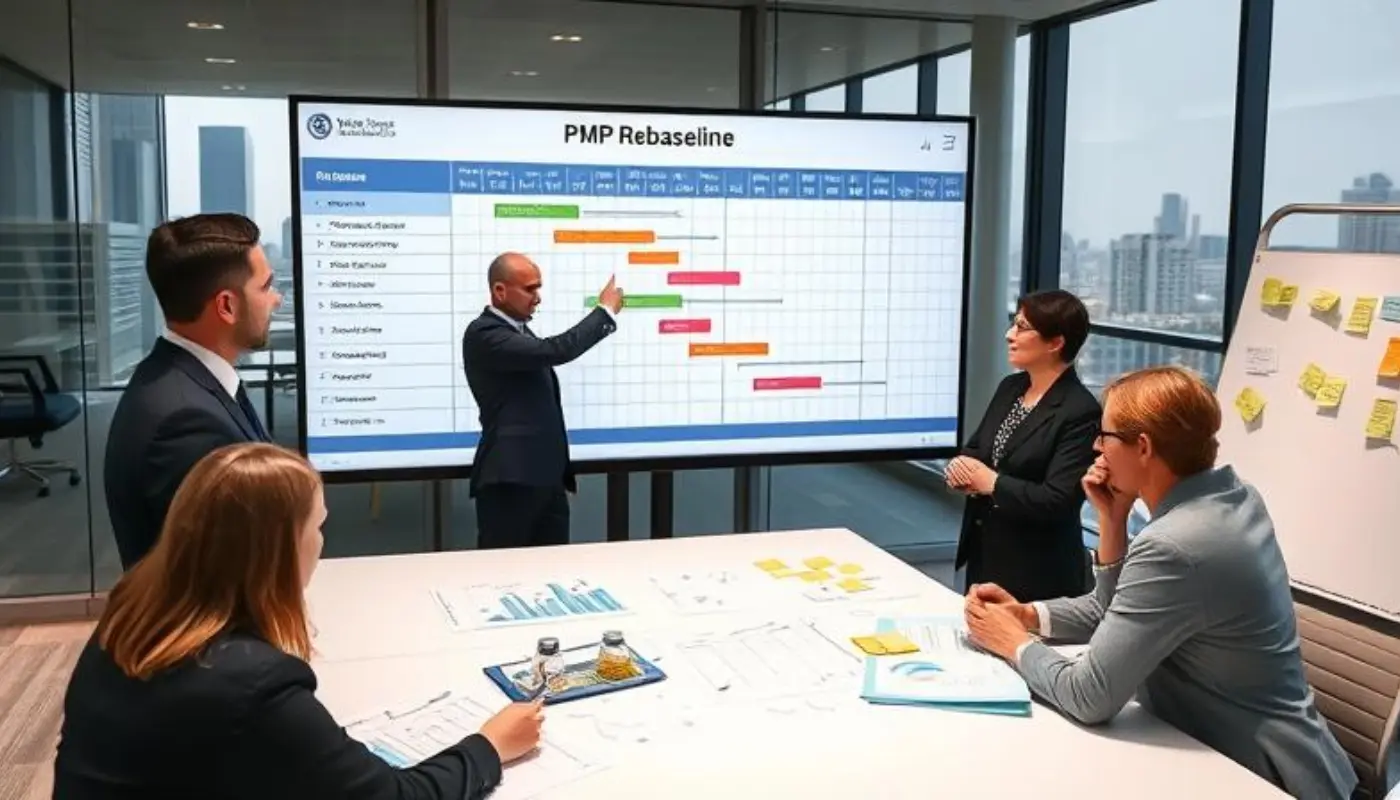
A PMP rebaseline is the formal replacement or adjustment of an approved project baseline after an authorized change has materially altered the project’s scope, schedule, cost, or performance targets. Rebaselining is not a way to hide poor performance or make past variances disappear. The project manager should first analyze the variance, document the cause, obtain approval through the change control process, preserve the original baseline, and then establish a clearly dated new reference point. A rebaselined project should show what was originally approved, what changed, why it changed, who approved it, and how future performance will be measured.
What Is a PMP Rebaseline? (And Why Do Project Managers Care?)
PMP rebaseline is a project management phrase, not a separate PMP certification or PMI credential. It describes the controlled act of updating an approved baseline when the project’s authorized direction changes significantly.
In simple rebaseline meaning, a project baseline is the approved reference used to compare actual performance with planned performance. It may include three connected baselines:
- Scope baseline: the approved scope statement, work breakdown structure, and WBS dictionary.
- Schedule baseline: the approved dates, durations, milestones, dependencies, and completion target.
- Cost baseline: the approved time-phased budget used to monitor spending and earned value.
Together, these elements form an integrated baseline. A project manager uses it to identify schedule variance, cost variance, scope movement, and forecast changes. It is a management control, not merely a file saved in scheduling software.
When people search for rebaseline project meaning, they are usually asking whether the original plan can change after work begins. The answer is yes, but only when the reason is valid, the impact is understood, and the change is formally approved. A routine delay does not automatically justify a new baseline.
PMI material on establishing a project baseline explains why an approved baseline is needed for meaningful performance measurement, including earned value analysis.PMI’s project baseline reference is a useful background for project managers reviewing this decision.
PMP Rebaseline Requirements
There is no universal percentage that automatically requires rebasing every project. The trigger depends on governance, contract terms, the performance measurement method, and the change control plan.
The most important requirement is an approved change. It may come from a sponsor, customer, regulator, supplier, discovery activity, or governance body, and should affect a major deliverable, key milestone, project end date, authorized budget, or agreed scope.
For a PMP rebaseline project, the change request should clearly document the approved scope, schedule, cost, impact analysis, and authorization record.
Good governance normally requires:
- A documented change request with a reason and business justification.
- An impact analysis covering scope, schedule, cost, quality, resources, procurement, risk, and stakeholders.
- Approval from the sponsor, customer, change control board, or other authorized decision-maker.
- A version-controlled record of the original baseline and all approved revisions.
- Communication of the new expectations to the project team and affected stakeholders.
The terms re-baselined, re-baselined, and rebaseline all describe the same general idea. The spelling varies, but the control requirement does not: a new baseline must be traceable to an approved decision.
The Real Rebaseline Decision: When Is It Justified?
Rebaselining is justified when the approved plan no longer represents the work the organization has authorized. Examples include a customer-approved scope expansion, regulatory requirement, funding change, major design decision, supplier replacement, or accepted change to the delivery date.
A re-baseline may also be appropriate after a recovery decision changes the remaining work. The sponsor may approve a smaller release, additional funding, a different solution, or a new delivery sequence.
Do not rebaseline merely because:
- Activities are late but the original target can still be recovered.
- Actual costs are higher than planned and no corrective decision has been approved.
- The team wants the variance report to look better.
- A manager wants to erase unfavorable historical performance.
- Forecasts are uncertain but the project scope has not changed.
This distinction protects variance analysis. If every unfavorable result leads to a new baseline, the project loses its ability to show whether work was delivered as promised. Past performance should remain visible while the approved future plan is updated.
Decoding the PMP Rebaseline Process and Baseline Components
Rebaselining should follow a controlled sequence. The method can be adapted to predictive, hybrid, or regulated environments, but the decision trail should remain clear.
1. Identify the Change or Condition
Record the issue, risk, assumption, decision, or external condition that may make the current plan invalid. Do not change the baseline for a rumor or informal request.
2. Analyze the Impact
Compare the current baseline with realistic alternatives. Assess scope, activities, critical path, milestones, resources, cost accounts, contracts, quality, risks, benefits, and downstream dependencies.
3. Prepare the Change Request
State the reason, recommended option, alternatives, assumptions, impact, implementation date, and decision required. Separate completed work from remaining work; do not rewrite history.
4. Obtain Formal Approval
Route the request through change control. Confirm the approval threshold and record the decision, date, conditions, and responsible authority.
5. Preserve the Old Baseline
Save a read-only copy of the original records. Label the new version with an effective date and revision number. The original baseline remains essential for lessons learned, contract analysis, benefits review, and accountability.
6. Update the Remaining Plan
Revise the schedule, WBS, budget, resource plan, risk register, procurement documents, assumptions, milestones, and reporting thresholds as needed. Recalculate the critical path and confirm the plan is achievable. Changing only the finish date is incomplete.
7. Communicate and Monitor
Explain what changed, what did not change, when the new baseline takes effect, and how performance will be measured. Use the rebaselined plan for future reporting while retaining the prior baseline and change history.
Rebaseline, Forecast, and Recovery Plan: What Is the Difference?
These terms are often confused. A forecast estimates what may happen; it does not change the approved plan. A recovery plan describes corrective actions intended to return the project to existing targets, such as fast-tracking, crashing, resequencing, or adding resources.
Re-baselining changes the approved reference point after an authorized decision. It does not itself recover a project. A team can recover without rebaselining, or rebaseline after a sponsor approves a new target.
The practical order is usually:
- Measure actual performance against the current baseline.
- Forecast the likely outcome.
- Evaluate corrective actions and alternatives.
- Submit an approved change if the authorized plan must change.
- Rebaseline only the approved future plan and preserve historical data.
Tactics for a Controlled PMP Rebaseline
Experienced project managers treat rebaselining as a governance decision and communication event.
- Use a baseline change log showing the original version, revision date, reason, approval, and affected documents.
- Keep actual progress, actual costs, and completed milestones tied to the original reporting periods.
- Separate approved scope changes from scope creep. Uncontrolled additions should be escalated, not silently absorbed.
- Recheck the critical path after changing logic, durations, resources, or constraints.
- Align the schedule baseline and cost baseline so the reporting period and budget timing remain consistent.
- Use earned value management carefully; a new performance measurement baseline should not disguise earlier cost or schedule variance.
- Ask stakeholders to confirm acceptance criteria, funding limits, decision rights, and the new completion target.
In Microsoft Project or Primavera, avoid selecting every task automatically. Completed work should remain historical; update future work packages, milestones, and authorized budget according to the decision record.
Common PMP Rebaseline Mistakes
The most damaging mistake is changing the baseline before approval. Another is overwriting the original file. Without the earlier version, the team cannot explain the original commitment or measure the change’s effect.
Project managers also rebaseline too broadly. If one supplier milestone changes, the entire project may not need a new cost and scope baseline. Conversely, changing only a final date when scope, resources, and budget changed produces an inconsistent plan.
Poor communication creates another risk: team members may use the old schedule while sponsors report against the new one. Issue a baseline change notice and publish one controlled version.
Your Next Move
If your project is falling behind, do not begin by asking how to make it rebaselined. Begin by asking whether the approved scope, schedule, cost, or delivery conditions have changed. Then compare the current plan with the forecast, document the impact, and take the decision through formal change control.
Before approving a PMP rebaseline, confirm five facts:
- What changed?
- Why is the change authorized?
- Which baseline components are affected?
- How will historical performance remain visible?
- Who approved the new reference point?
Once those answers are recorded, publish the revised plan, brief the team, and monitor it against measurable targets. A disciplined re-baseline does not hide project history; it gives the team an honest, approved plan for the work that remains.