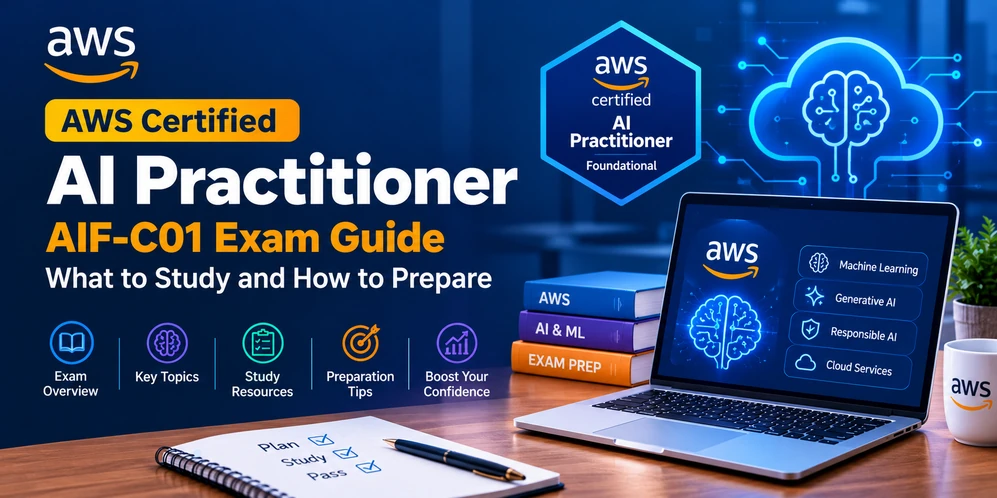
The AWS Certified AI Practitioner AIF-C01 exam is about understanding AI and knowing where AWS services fit. You don’t need to build a model or write code for the exam. You do need to recognize useful AI applications, understand their limits, and think about responsible use.
This guide covers the official exam format, domains, and objectives, then offers a practical study approach. The exam details below follow AWS’s current certification page and AIF-C01 exam guide.
Who Is the AWS Certified AI Practitioner Exam For?
AWS describes the intended candidate as someone familiar with AI and machine learning on AWS who uses AI/ML solutions but may not build them. The exam guide says candidates may have up to six months of exposure to AI/ML technologies on AWS. It also recommends familiarity with core AWS services, IAM, the shared responsibility model, and AWS service pricing models.
That makes the certification relevant to people in roles such as business analysis, IT support, marketing, sales, product management, and project management. It can also suit cloud learners who want a first structured look at AI concepts on AWS.
The exam isn’t a coding test. AWS lists tasks such as developing AI/ML models, building pipelines, tuning models, and doing advanced statistical analysis as outside the expected scope.
The exam has 65 questions and a 90-minute time limit. AWS says 50 questions are scored and 15 are unscored; you won’t know which questions are unscored while taking the exam. You can take it at a Pearson VUE test center or through online proctoring.
| Exam detail | Information |
|---|---|
| Level | Foundational |
| Exam code | AIF-C01 |
| Questions | 65 total: 50 scored and 15 unscored |
| Duration | 90 minutes |
| Passing score | 700 on a scaled score of 100–1,000 |
| Delivery | Pearson VUE test center or online proctored exam |
The AWS AI Practitioner exam question types are multiple choice, multiple response, ordering, and matching. Some questions ask you to pick one answer; others ask you to select every correct option or arrange responses in the right order. Read the instructions carefully, especially on questions where more than one response may be correct.
AWS uses a compensatory scoring model. You need to pass the exam overall; you don’t need a separate passing score in each domain. Unanswered questions count as incorrect, and AWS states there’s no penalty for guessing.
AIF-C01 Exam Domains and Weights
The AIF-C01 exam guide divides scored content into five domains. The weights help you decide where to spend more study time, though every domain is worth reviewing.
| Exam domain | Weight |
|---|---|
| Fundamentals of AI and ML | 20% |
| Fundamentals of GenAI | 24% |
| Applications of Foundation Models | 28% |
| Guidelines for Responsible AI | 14% |
| Security, Compliance, and Governance for AI Solutions | 14% |
Applications of Foundation Models is the largest domain. Combined with Fundamentals of GenAI, these areas make up 52% of the scored content. Don’t take that to mean the other topics are optional: all five domains are included in AWS’s exam guide.
Domain 1: Fundamentals of AI and ML
This domain covers basic terms, practical use cases, and the AI/ML development lifecycle. AWS’s objectives include distinguishing AI, ML, generative AI, deep learning, and agentic AI. Candidates should also recognize types of data and learning, and understand when AI or ML may—or may not—be appropriate for a problem.
If you’re new to the subject, start with AI and ML concepts for beginners: what the terms mean, what problems they can solve, and how approaches such as classification, regression, and clustering differ. The exam tests your understanding of the concepts, not your ability to code them.
Domain 2: Fundamentals of Generative AI
This domain covers generative AI concepts, capabilities, limitations, and AWS technologies used to build generative AI applications. Topics include tokens, embeddings, vectors, prompt engineering, foundation models, and multimodal models. AWS lists use cases such as summarization, translation, content generation, and AI assistants.
Know what generative AI can do and where it can fall short. AWS’s objectives call out hallucinations, inaccuracy, interpretability, and nondeterministic outputs. In a scenario, think about the task, the model’s limitations, and what review or safeguards may be needed.
Domain 3: Applications of Foundation Models
This domain covers how to design applications using foundation models, select prompt techniques, understand training and fine-tuning, and evaluate model performance. Foundation model use cases vary, so consider factors such as the task, model capability, latency, modality, and customization needs.
Amazon Bedrock exam topics include its role in building generative AI applications. The guide also covers retrieval-augmented generation (RAG), prompt engineering, model customization, and evaluation. Focus on what each approach is for and how you would tell them apart in a practical example.
Domain 4: Guidelines for Responsible AI
Responsible AI guidelines include fairness, inclusivity, robustness, safety, and veracity. AWS also expects candidates to understand transparency and explainability, dataset characteristics, legal risks, and ways to identify or monitor bias and trustworthiness.
When you read a question about an AI system, consider who may be affected and whether the results can be reviewed or explained. Be familiar with the purpose of AWS tools mentioned in the exam guide, such as Amazon Bedrock Guardrails and model evaluation features.
Domain 5: Security, Compliance, and Governance for AI Solutions
This domain covers ways to secure AI systems and recognize governance and compliance requirements. AWS’s objectives include IAM roles and permissions, encryption, privacy, secure data practices, and the shared responsibility model. They also mention risks such as prompt injection and data leakage.
The governance portion includes data lifecycle, residency, monitoring, retention, and review processes. Learn the role of services named in the guide, including AWS Config, AWS CloudTrail, AWS Artifact, and Amazon Bedrock Guardrails. You don’t need to design an enterprise governance program; you should understand what these controls and services help address.
AWS AI Practitioner Exam Difficulty
The exam is foundational, but it covers a wide range of topics. It may feel demanding if AI terminology is new to you or if you’ve memorized service names without learning what each service does.
A useful way to judge AWS AI Practitioner exam difficulty for your own background is to explain each topic in plain language, match it to a use case, and identify its limits. The official objectives are a good boundary for your study: AWS doesn’t expect advanced coding, model tuning, or pipeline development for this exam.
How to Prepare for the AWS AI Practitioner Exam
A good AWS AI Practitioner study guide should follow the official exam objectives, give you time to practice, and help you revisit topics you haven’t mastered. Here’s a straightforward AIF-C01 preparation strategy.
1. Make a checklist from the exam guide
Write down each domain and task statement. Mark each item as “new,” “needs review,” or “comfortable.” This turns the AIF-C01 exam guide into a working checklist and helps you see where to begin.
2. Set your study time by domain weight
Give extra time to Applications of Foundation Models and Fundamentals of GenAI, since they make up the largest combined share of scored content. Still schedule a review for all five domains. The weights guide your effort; they don’t tell you exactly what questions will appear.
3. Study through examples
For each concept, write one short business example. Ask what the organization wants to achieve, whether AI is a suitable fit, and what risks or limitations deserve attention. Examples make it easier to apply knowledge to questions you haven’t seen before.
4. Compare AWS services in your own notes
Create a simple table with each relevant service, its purpose, and an example use. Include the AWS AI and machine learning services named in the exam materials, such as Amazon Bedrock and Amazon SageMaker AI. AWS recommends familiarity with these core services.
5. Practice all four question types
Use practice questions to check your understanding across the five domains. Try multiple choice, multiple response, ordering, and matching questions. When you miss one, note the concept behind the mistake rather than memorizing that question’s answer.
6. Do a final review of weak areas
A few days before the exam, revisit the topics you marked “new” or “needs review.” Try explaining each one without looking at your notes, then test yourself with a fresh example. Avoid spending your last study sessions on advanced tasks outside the exam scope.
AIF-C01 Exam Readiness Checklist
You’re getting close to AIF-C01 exam readiness when you can:
- Explain core AI, ML, and generative AI concepts in your own words.
- Recognize when AI, traditional ML, or a foundation model may fit a use case.
- Describe the purpose of AWS services named in the exam objectives.
- Spot responsible AI, security, compliance, and governance considerations.
- Work through multiple-choice, multiple-response, ordering, and matching questions.
- Explain what you need to review after getting a practice question wrong.
Start with the current AWS exam guide, organize your AIF-C01 study plan by domain, and use practice questions to find gaps. For additional certification information, visit AWS Certified AI Practitioner certification in New York.
Frequently Asked Questions
How many questions are on the AIF-C01 exam?
There are 65 questions: 50 scored and 15 unscored. AWS does not identify the unscored questions during the exam.
What is the passing score?
AWS reports results on a scaled score from 100 to 1,000. The minimum passing score is 700.
Do I need coding experience?
AWS lists developing or coding AI/ML models and algorithms as outside the target candidate’s expected tasks. The exam focuses on foundational concepts, use cases, and AWS AI tools.
Ready to Start Your AWS Certified AI Practitioner Certification Journey?
Contact our team for AWS Certified AI Practitioner certification online training, study resources, practice questions, and exam preparation support.
Contact UsReview AWS’s current exam guide once more before test day, then use your practice results to focus on any domains that still need attention. That final review can help you approach the AIF-C01 exam with a clear plan.