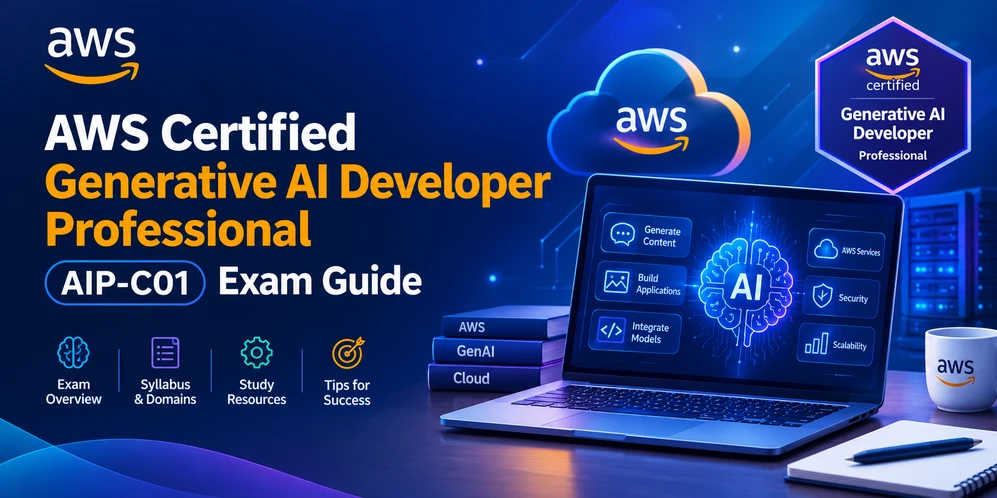
The AWS Certified Generative AI Developer – Professional certification is for developers who build real applications with generative AI. The AIP-C01 exam looks at the work behind those applications: choosing a foundation model, connecting it to useful data, integrating it with other systems, and keeping it secure and reliable after deployment.
This guide covers the exam format, objectives, domain weights, recommended experience, and a practical study plan. It is aimed at working IT professionals and developers. Beginners can use it to understand the path ahead, but the exam assumes more than basic familiarity with AWS or generative AI.
What the certification covers
The certification validates practical skills for putting generative AI solutions into production using AWS technologies. That includes integrating foundation models into applications and business workflows, building retrieval systems, implementing agents, and monitoring how a solution performs.
You’ll also need to think about what can go wrong. A model may return an inaccurate answer, retrieve irrelevant information, expose sensitive data, or use a tool in an unintended way. The exam expects candidates to consider these risks as part of design and implementation.
The AIP-C01 exam objectives include:
-
Selecting and integrating foundation models for a use case
-
Preparing data and building retrieval-augmented generation (RAG) solutions
-
Using vector stores, embeddings, and knowledge bases
-
Applying prompt engineering and management
-
Implementing agentic AI and tool integrations
-
Protecting applications with security, governance, and Responsible AI practices
-
Testing outputs and troubleshooting application problems
-
Improving cost, latency, performance, and business value
The focus is application development and operations. AWS lists model development and training, advanced machine-learning techniques, and data or feature engineering as outside the target candidate’s expected responsibilities.
AIP-C01 exam format
The exam lasts 180 minutes and contains 75 questions. AWS identifies 65 as scored questions; the remaining 10 are unscored and are not marked as such during the exam. Questions are multiple choice or multiple response. Unanswered questions count as incorrect, and AWS does not subtract points for guessing.
Exam detailAIP-C01 informationCertification levelProfessionalDuration180 minutesTotal questions75Scored questions65Unscored questions10Question typesMultiple choice and multiple responsePassing score750 on a scaled score of 100–1,000
AWS uses an overall passing score. You do not have to pass each domain separately, although the score report may show how you performed across sections.
AIP-C01 exam domains and weights
The exam guide assigns a percentage of scored content to each domain. Use the weights to plan your study time, while still reviewing all five areas.
Exam domainWeightFoundation Model Integration, Data Management, and Compliance31%Implementation and Integration26%AI Safety, Security, and Governance20%Operational Efficiency and Optimization for GenAI Applications12%Testing, Validation, and Troubleshooting11%
These percentages describe the scored exam content; they do not guarantee an exact number of questions from each domain. AWS also notes that its exam guide is not a complete list of every possible exam topic.
Domain 1: Foundation model integration, data management, and compliance
This is the largest domain. It covers understanding a business need, choosing and configuring a foundation model, preparing data, and building vector-store and retrieval solutions.
For RAG, be ready to follow the whole path: prepare source material, create embeddings, retrieve relevant content, and pass that content to a model. Think about what makes retrieval useful. Poorly prepared data or irrelevant search results can undermine an otherwise capable model.
Amazon Bedrock and foundation model integration are important areas to study, but don’t limit your preparation to memorizing product names. Practice explaining why one model or retrieval approach fits a particular use case, considering accuracy, data needs, compliance, and performance.
Domain 2: Implementation and integration
This domain asks how generative AI fits into an application or an existing business system. Topics include model APIs, deployment strategies, enterprise integration, agentic AI, and tool use.
An agent may need to call a service, retrieve information, or complete a sequence of tasks. Study how to give it the tools it needs while limiting what it can access. Also review common integration patterns, including APIs, event-driven designs, serverless components, and containers. Scenario questions may ask you to choose an approach that balances reliability, control, and the needs of the application.
Domain 3: AI safety, security, and governance
This domain covers controls for model inputs and outputs, privacy, access, governance, and responsible use. Study how to reduce risks such as prompt injection, unsafe content, and exposure of sensitive information.
Think through security at each step: who can access the data, what tools a model can call, how outputs are checked, and what activity should be logged. Content moderation and safety controls matter, but they work best as part of a broader design that includes permissions, validation, and oversight.
Domain 4: Operational efficiency and optimization
Once an application is working, it still needs to meet its cost and performance targets. This domain includes model choice, token use, caching, latency, throughput, and monitoring.
For example, a long prompt may provide useful context but increase processing time and cost. A smaller model may be sufficient for routine requests, while a more capable model may be needed for harder tasks. Monitoring token use, response times, retrieval quality, and output quality can help a team spot problems and decide what to improve.
Domain 5: Testing, validation, and troubleshooting
Generative AI testing has to look beyond whether a request succeeded. You need to assess whether the answer is relevant, accurate, consistent, and useful for the task.
Review ways to test model outputs, retrieval quality, and agent task completion. Also understand common failure patterns: a prompt may be unclear, retrieved context may be irrelevant, input may exceed the context window, or an API integration may fail. Good troubleshooting starts by identifying where in the workflow the problem occurred.
AWS Generative AI Developer Professional requirements
AWS describes the target candidate as having at least two years of experience building production-grade applications on AWS or with open-source technologies, a general AI/ML or data engineering background, and one year of hands-on experience implementing generative AI solutions. AWS also recommends knowledge of compute, storage, networking, security, identity, infrastructure as code, monitoring, and cost optimization.
These are recommendations for the target candidate, not formal prerequisites. AWS does not require another certification before you take AIP-C01. Still, if you have not built applications or worked with cloud services, start there before relying on an exam guide. Hands-on familiarity will make the exam scenarios easier to reason through.
How to prepare for the AIP-C01 exam
A useful AWS Generative AI Developer Professional study guide should connect the official objectives to practical work. Try this sequence:
-
Review the exam guide. Mark each objective as familiar, partly understood, or new. Give extra time to the 31% and 26% domains, but don’t skip the others.
-
Build a small application. Connect a foundation model to an application, then add retrieval with a vector store or knowledge base. Follow how the data moves through the system.
-
Add a tool or agent workflow. Decide what the agent can do, what it must not do, and what should happen if a tool call fails.
-
Test safety and quality. Try unclear inputs, irrelevant source material, sensitive data, and requests that should be blocked. Check both the retrieved context and the final response.
-
Review trade-offs. For each design choice, consider model capability, latency, cost, security, and operational effort. Be ready to explain why an option fits the scenario.
-
Use practice questions to find gaps. AIP-C01 practice questions are most useful when you review the reasoning behind each answer, not when you memorize a key.
-
Check your readiness. Take a timed practice assessment, revisit weak areas, and repeat practical exercises until you can explain your choices clearly.
AWS recommends reviewing the exam guide, refreshing knowledge where needed, practicing with official materials, and taking an official practice exam to assess readiness.
AIP-C01 exam difficulty and career benefits
AWS does not publish an official difficulty rating. The exam may be challenging if you lack hands-on experience because it spans design, implementation, security, operations, and testing. The strongest preparation is being able to apply the concepts to a working solution, not simply recognize terminology.
The certification can help demonstrate practical generative AI development skills to employers and teams. It may be relevant to cloud developers, AI application engineers, and professionals integrating AI into existing systems. It validates knowledge, but it does not guarantee a particular job, promotion, or salary.
Frequently asked questions
Is AIP-C01 suitable for beginners?
The exam is intended for experienced developers. Beginners can work toward it, but should first gain experience with application development, AWS services, and generative AI.
Do I need another AWS certification first?
No. AWS does not require a prior certification. Some related AWS credentials may help build background knowledge, but they are optional.
Does the exam cover model training?
Model development and training are outside the target candidate’s expected scope. The exam focuses on integrating foundation models into applications and operating those solutions.
Ready to Start Your AWS Certified Generative AI Developer Certification Journey?
Contact our team for AWS Certified Generative AI Developer certification online training, study resources, practice questions, and exam preparation support.
Contact UsBefore you schedule AIP-C01, compare your experience with the exam objectives and identify which domains need more practice. For additional certification information, see the AWS Certified Generative AI Developer Professional certification.