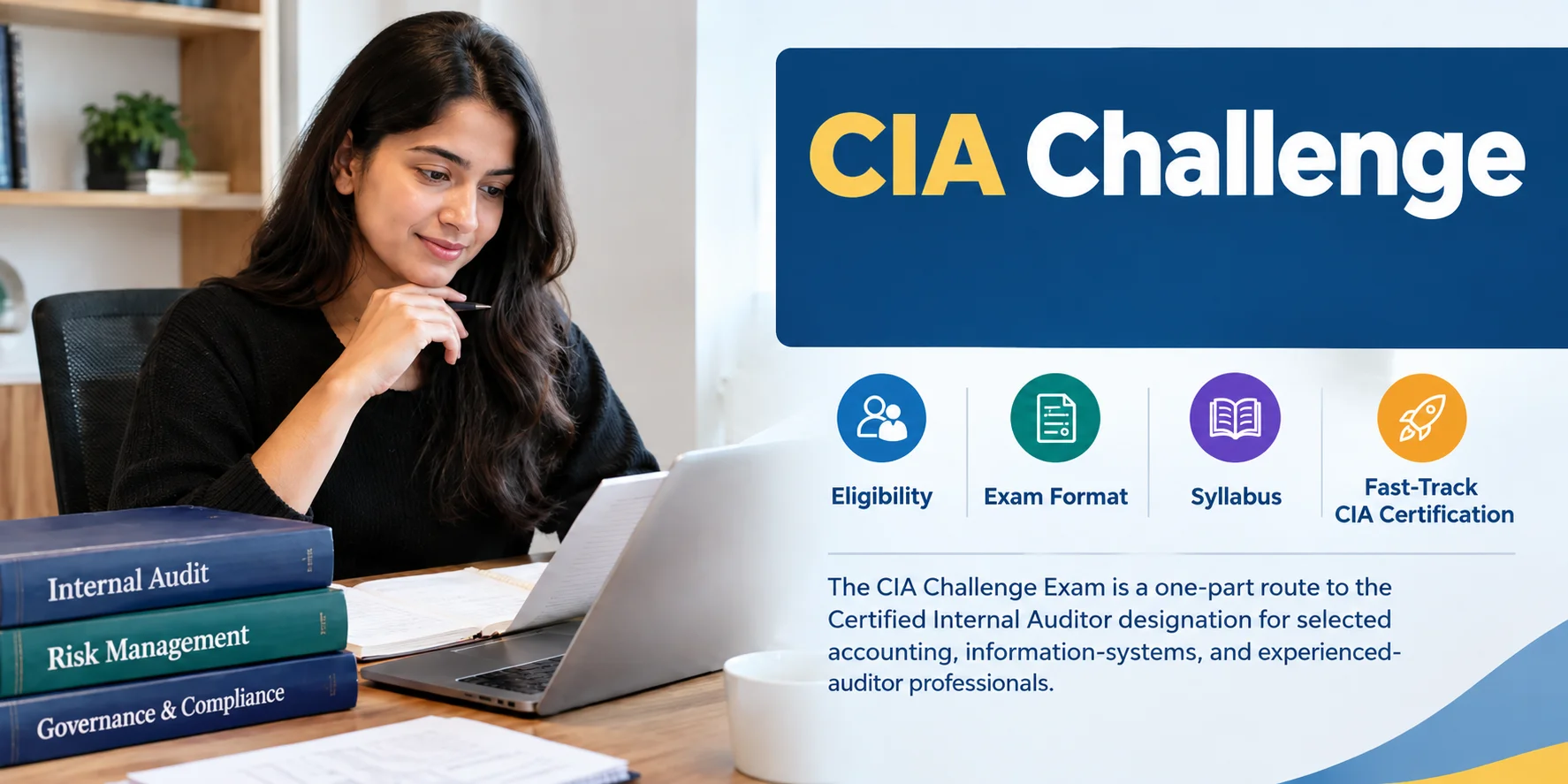
The CIA Challenge Exam is a one-part route to the Certified Internal Auditor designation for selected accounting, information-systems, and experienced-auditor professionals. Depending on the pathway, candidates may need an active approved CPA or CA credential, CISA status, or at least 10 years of internal-audit-related experience. The current exam has 150 multiple-choice questions and a 180-minute limit. Its June 2026 syllabus is aligned with the 2024 Global Internal Audit Standards and covers professionalism, audit planning, engagement planning, engagement performance, and results monitoring. Eligibility, documents, testing windows, and pilot rules differ, so applicants should verify their pathway directly with The IIA before registering.
What Is the CIA Challenge?
The CIA Challenge is a specialized one-part examination for professionals with substantial accounting, information-systems, or internal-audit knowledge. An approved candidate takes one comprehensive exam focused on practical internal audit application.
The unified exam covers governance, risk, controls, ethics, planning, evidence, reporting, technology, and follow-up. The structure is faster, but the standard remains demanding.
Why the CIA Challenge Matters
The CIA credential helps employers identify professionals who understand assurance, governance, risk management, and internal controls. The challenge route adds internal-audit depth to accounting or technology experience and is relevant to cybersecurity, privacy, third-party risk, resilience, fraud, artificial intelligence, and regulation.
What Is a CIA in Accounting?
In accounting, CIA means Certified Internal Auditor. It is not a replacement for a CPA or CA license. CPA and CA qualifications generally demonstrate accounting and external-audit competence, while the CIA focuses on assurance, governance, risk management, controls, and audit communication.
The CIA in accounting complements careers in internal audit, risk advisory, controls, compliance, and assurance.
Who Can Apply? CIA Challenge Exam Eligibility
Eligibility depends on the pathway. The IIA currently offers accounting and information systems pathways year-round. The professional experience pathway was a pilot, and applications for it are now closed.
Accounting pathway: Applicants must be active CPA or CA holders from an accounting body approved by The IIA. Students are not eligible. Applicants need to provide the required credential and identity documents, and must receive application approval before registering for the exam. Check The IIA’s current approved-body list before applying.
Information systems pathway: Applicants must hold an active CISA designation and provide proof of good standing, along with government-issued photo ID.
Professional experience pilot: This pathway required at least 10 years of experience in internal audit or related fields, but it is closed to new applications. If you applied before the deadline, check your application status and exam deadline in CCMS.
The IIA reviews applications and makes the final eligibility decision. Don’t assume a similar credential qualifies unless it appears on the IIA’s approved list.
CIA Qualification Standard Requirements
The CIA qualification standard requirements are pathway-specific. The key test is whether the candidate meets the selected pathway, provides accurate evidence, and receives application approval.
Before applying, check:
- Whether the CPA, CA, or CISA credential is currently accepted.
- Whether professional experience fits the experienced-auditor route.
- Whether identity documents match the application.
- Whether another IIA certification program is already active.
- Whether the chosen testing window fits the registration period.
For current pathway rules, approved bodies, documents, and program notices.
Check Your CIA Challenge Exam Pathway
Choose the option that best matches your current qualification or experience for an initial pathway check.
This tool is for general guidance only. Confirm current requirements and your application status with The IIA before registering.
CIA Challenge vs. Traditional CIA Program
- CIA Challenge: one comprehensive exam for approved candidates.
- Traditional CIA: three separate exam parts through the regular program.
- CIA Challenge: selected credentialed or highly experienced professionals.
- Traditional CIA: broader access for candidates who meet regular CIA requirements.
- Both routes: award the Certified Internal Auditor designation after completion.
Choose the challenge route only after confirming eligibility.
CPA / CA Fast-Track CIA Path
The CPA / CA fast-track CIA path builds on financial statements, audit evidence, ethics, and controls. It does not remove the need to study risk-based planning, engagement objectives, evidence, analytics, reporting, residual risk, and management action plans.
CIA Challenge Exam Format
The CIA Challenge Exam is a computer-based, multiple-choice exam with 150 questions and 180 minutes. It tests judgment and application, so preparation should include scenarios rather than definition memorization.
Expect questions involving:
- Audit planning and risk prioritization.
- Independence, objectivity, and ethics.
- Control design and operating effectiveness.
- Evidence quality and documentation.
- Data analytics and technology-enabled auditing.
- Conclusions, recommendations, reporting, and follow-up.
For the Accounting and Information Systems pathways, testing windows generally occur in February, June, September, and November. Candidates must receive application approval before registering and scheduling.
The Professional CIA Challenge Exam pilot currently has November 2026 and February 2027 testing windows.
CIA Challenge Exam Syllabus: June 2026
The CIA Challenge Exam syllabus effective June 2026 has five sections. The percentages below are the published exam weights. The listed topics summarize the IIA’s learning objectives; they are not a complete substitute for the official syllabus.
| Section | Exam weight | Topics to study |
|---|---|---|
| A. Internal Audit Professionalism and Quality | 20% | The internal audit mandate; board and chief audit executive responsibilities; independence and objectivity; the Three Lines Model; confidentiality; the quality assurance and improvement program; communicating nonconformance with the Global Internal Audit Standards; and internal audit performance measures. |
| B. Internal Audit Operations and Audit Plan | 15% | Managing audit operations and resources; internal audit strategy; communication with senior management and the board; defining the audit universe; identifying potential engagements; developing and updating a risk-based audit plan; and coordinating with other assurance providers. |
| C. Engagement Planning | 20% | Setting engagement objectives and scope; choosing evaluation criteria; assessing risks and controls; considering technology, cybersecurity, privacy, business continuity, finance, fraud, and business processes; selecting the engagement approach; and preparing procedures, work programs, and resources. |
| D. Engagement Performance | 25% | Gathering and evaluating evidence; using technology and data analysis; mapping processes; applying analytical review; comparing conditions with criteria; assessing findings and root causes; preparing workpapers and conclusions; supervising work; and communicating with stakeholders during the engagement. |
| E. Engagement Results and Monitoring | 20% | Communicating results; preparing reports and action plans; handling disagreements and scope limitations; assessing residual risk; communicating unacceptable risk acceptance; monitoring management action plans; and escalating overdue or inadequate actions. |
Section A: Internal Audit Professionalism and Quality
Study the internal audit mandate and the respective roles of the board, senior management, and chief audit executive. Review organizational independence, reporting lines, scope restrictions, objectivity impairments, conflicts of interest, confidentiality, and the Three Lines Model. The section also covers quality assessments, nonconformance reporting, and performance measures.
Section B: Internal Audit Operations and Audit Plan
Review how the audit function is organized, monitored, and resourced, including staffing, budgeting, technology, training, and external service providers. Understand how the internal audit strategy supports organizational priorities, how the audit universe is maintained, and how risk assessments inform a dynamic audit plan. Study coordination with other assurance providers and how their work is evaluated.
Section C: Engagement Planning
Prepare to define objectives and scope, select suitable criteria, and assess risks and controls for the activity under review. The IIA’s syllabus includes topics such as cybersecurity and IT controls, data privacy, business continuity, supply chain and third-party processes, finance and accounting, fraud risks, and emerging technologies. You should also understand how to choose an engagement approach and develop procedures and a work program.
Section D: Engagement Performance
This is the largest section by weight. Study how to obtain relevant information and assess whether evidence is sufficient, reliable, and relevant. The syllabus includes process mapping, data analysis, analytical review, identifying root causes, documenting workpapers, drawing conclusions, supervising the engagement, and communicating with stakeholders.
Section E: Engagement Results and Monitoring
Review how to communicate accurate, objective, clear, concise, constructive, complete, and timely results. Study report content, recommendations and management action plans, residual risk, risk acceptance, follow-up, and escalation when actions are not implemented adequately.
Fraud, risk assessment, technology, and the Global Internal Audit Standards appear across the syllabus; they are not separate weighted sections. For the detailed learning objectives, use the IIA’s official CIA Challenge Exam syllabus.
Proven Preparation Strategy
A focused plan can follow four stages:
- Confirm eligibility, download the syllabus, and take a diagnostic test.
- Study Sections A, B, and C with notes on standards, audit planning, risk, controls, and engagement design.
- Give extra time to Section D because it carries 25%; practise evidence, analytics, workpapers, findings, supervision, and communication.
- Revise Section E, complete timed mocks, and review incorrect answers by topic.
For each scenario, identify the auditor’s role, the risk, the relevant principle, and the most defensible next action.
Overview of IIA Certifications
The IIA offers the traditional CIA,CIA Challenge Exam pathways, Certification in Risk Management Assurance, Internal Audit Practitioner, and other internal-audit certifications. Each has different entry rules, exam structures, and renewal obligations.
Career Opportunities & Benefits
The CIA Challenge can support progression into:
Target Career Roles
- Internal auditor
- Senior internal auditor
- Audit manager
- Chief audit executive
- Risk and controls specialist
- Compliance or assurance manager
- Technology and systems auditor
- GRC consultant
Key Program Benefits
- Adds an internal-audit credential to an existing qualification.
- Connects accounting or technology experience with risk and governance.
- Supports audit leadership and assurance roles.
- Demonstrates knowledge of current internal-audit standards.
- Offers one exam instead of three for eligible candidates.
CIA Challenge Exam for Experienced Professionals
The Professional CIA Challenge Exam was introduced as an experience-based pilot for candidates with at least 10 years in internal audit or related disciplines. Experience had to be documented through the required verification process.
As of October 2026, applications are closed. Only candidates who applied by September 30, 2026 can register for the November 2026 testing window, subject to application approval. Another pilot testing window is scheduled for February 2027. The IIA is evaluating the pathway’s future.
Ready to Start Your CIA Challenge Certification Journey?
Contact our team for CIA Challenge certification online training, study resources, practice questions, and exam preparation support.
Contact UsFrequently Asked Questions (FAQ)
Is the CIA Challenge easier than the traditional CIA exam?
It is shorter in the number of exams, but not automatically easier. One exam covers broad knowledge in 150 questions and 180 minutes.
Who is eligible for the CIA Challenge?
Approved active CPA or CA holders, qualified CISA holders, and selected experienced internal-audit professionals may qualify under separate pathways.
Does the CIA Challenge award the same CIA certification?
Yes. Successful candidates earn the Certified Internal Auditor designation, not a different grade of CIA.
How should I prepare?
Use the syllabus, study by weighting, practise application-based questions, and complete timed mocks. Engagement Performance represents 25% of the syllabus.
How hard is it to get into the CIA?
For the certification, difficulty depends on eligibility and preparation. The route is selective and requires application approval. The U.S. intelligence agency is a separate career process unrelated to this credential.
Take the Next Step Toward CIA Certification
Identify your pathway, verify your credential or experience, collect the documents, and select the correct testing window. Then prepare from the June 2026 syllabus and practise application-based audit decisions.