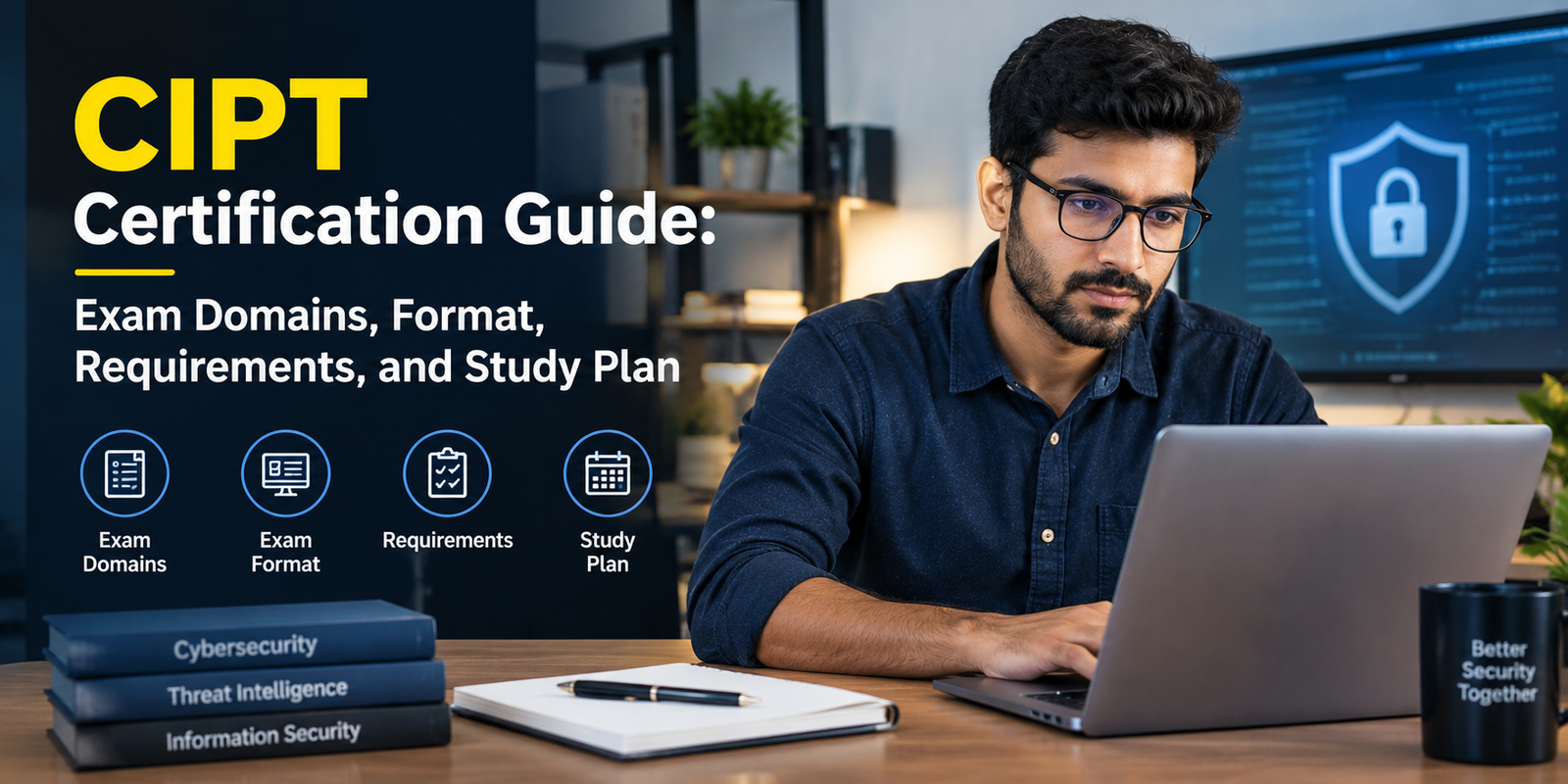
The CIPT certification is for professionals who need to apply privacy principles to technology, software, and data practices. This CIPT certification guide explains what the credential covers, who it may suit, how the exam works, and how to prepare using IAPP resources. It is based on IAPP’s current certification page, exam information, and Body of Knowledge.
CIPT stands for Certified Information Privacy Technologist. The IAPP CIPT certification focuses on reducing privacy risks through technical and organizational practices, including data minimization, access controls, secure software, privacy-by-design, and privacy engineering. Candidates should use the current IAPP materials as their source of truth because exam policies and content can change.
CIPT certification at a glance
| Item | Current information |
|---|---|
| Credential | Certified Information Privacy Technologist (CIPT) |
| Issuing organization | International Association of Privacy Professionals (IAPP) |
| Exam format | 90 multiple-choice questions |
| Allotted exam time | 2.5 hours |
| Recommended study time | At least 30 hours |
| Main study reference | CIPT Body of Knowledge and Exam Blueprint |
| Current Body of Knowledge version | Version 4.0.0, effective September 1, 2025 |
IAPP describes the CIPT as a credential for using technical solutions to build data protection into products and services. It is accredited by the ANSI National Accreditation Board under ISO/IEC 17024.
What does the Certified Information Privacy Technologist certification cover?
The Certified Information Privacy Technologist certification focuses on the relationship between privacy and technology. It examines how professionals can recognize privacy risks, select appropriate controls, and incorporate data protection into systems and product decisions.
The credential is not a privacy law qualification alone. It brings together technical work and privacy responsibilities. For example, a team may need to translate a legal or policy requirement into a product setting, data-retention rule, access-control measure, or software change. CIPT candidates learn the concepts and vocabulary needed to contribute to those discussions.
This makes CIPT a specialized IAPP privacy certification for people who work with information technology, information security, software engineering, data governance, or privacy by design. IAPP describes the certification as relevant to professionals responsible for those areas.
Who should consider the IAPP CIPT certification?
The CIPT certification may be useful for professionals who influence how personal information is collected, used, protected, shared, retained, or deleted. Potential candidates include:
- IT and information security professionals
- Software engineers and product developers
- Privacy engineers and technology consultants
- Data governance, architecture, and systems professionals
- Professionals who support privacy audits or impact assessments
The CIPT certification for IT professionals can provide a structured way to learn how privacy requirements connect with system design and operational controls. Prior familiarity with technology can make the examples easier to understand, while experience with privacy, risk, or data handling can help candidates connect technical decisions to their impact on people.
IAPP’s published certification process describes purchasing the exam, preparing, scheduling the test, and activating the credential after passing. Review the current candidate handbook for the latest policies and procedural details before registering.
What are the CIPT exam domains?
The CIPT Body of Knowledge and Exam Blueprint is the main guide to the knowledge and skills assessed. Its current version, Version 4.0.0, became effective September 1, 2025. It organizes the exam into five domains and lists competencies and performance indicators for each.
| CIPT exam domain | Main areas covered |
|---|---|
| The privacy technologist’s role in the context of the organization | Privacy responsibilities, technical roles, risk frameworks, ethics, and cross-functional work |
| Data collection, use, dissemination, and destruction | Consent, data minimization, retention, disclosure, and privacy-enhancing techniques |
| Privacy risk management | Software security, tracking, surveillance, workplace technology, and risk monitoring |
| Privacy by design | Applying privacy principles and evaluating privacy risks in user experiences |
| Privacy engineering and privacy governance | Engineering objectives, data flows, development life-cycle risks, inventories, code reviews, and controls |
The first domain considers how a privacy technologist works with legal, compliance, cybersecurity, data governance, and other teams. It includes understanding roles and responsibilities, applying risk frameworks, and translating privacy requirements into technical or operational solutions.
The second domain follows personal information through its life cycle. Candidates should understand how to reduce collection, manage consent and notices, limit access and secondary uses, set retention practices, and reduce risk during disclosure and destruction. The domain includes privacy enhancing technologies and techniques such as anonymization, pseudonymization, and differential privacy.
The third domain covers privacy risk management in IT and technology environments. Topics include software privacy vulnerabilities, behavioral advertising, biometrics, location tracking, internet monitoring, artificial intelligence, and communications technologies. Candidates should understand how technical privacy controls and monitoring practices can reduce risk.
The fourth domain addresses privacy by design certification concepts, including applying privacy principles to product and user experience decisions. The fifth covers privacy engineering certification topics: managing privacy risks across development, understanding data flows, maintaining data inventories, conducting code reviews, and monitoring system behavior. Together, these areas connect privacy in technology with data protection in product development.
What is the CIPT exam format?
The CIPT exam has 90 multiple-choice questions and 2.5 hours of allotted testing time. IAPP’s exam FAQ notes that certification exams may include scenario-based and multi-select questions. In a multi-select question, candidates must choose the exact number of responses requested.
This CIPT exam format tests more than memorized definitions. A question may describe a product or data practice and ask which response best addresses the privacy risk. Candidates should be ready to apply concepts such as minimization, limited access, retention, or secure software practices to a situation.
IAPP also offers a CIPT practice exam with 90 questions developed from the same Body of Knowledge used for the certification exam. Use it to become familiar with question style and identify topics for further study. Practice questions can support preparation, but they do not replace a review of the official blueprint.
CIPT exam requirements and certification process
IAPP’s published process begins with purchasing the appropriate exam through its store. After purchase, the exam appears in the candidate’s IAPP account. IAPP states that candidates have one year to schedule and complete the test. When ready, they schedule through MyIAPP and take the exam at the confirmed location and time. Computer-based results are generally provided immediately after completion.
After passing, candidates must take the steps required to activate and maintain the credential. IAPP’s process includes continuing privacy education and credential maintenance for each two-year term. Check the current candidate handbook and certification page for exact, up-to-date requirements.
How to prepare for the CIPT exam
IAPP recommends at least 30 hours of study for each certification. Treat this as a baseline and allow more time if you are new to privacy engineering, data protection, or the technical concepts in the Body of Knowledge.
A focused CIPT exam preparation plan can follow these steps:
- Start with the current blueprint. Download the CIPT Body of Knowledge and Exam Blueprint from IAPP. Note the version and effective date so your materials align with the exam.
- Check your baseline knowledge. Read each competency and performance indicator. Mark concepts you can explain confidently and topics that need review.
- Study the domains in context. Connect each concept to a real technology decision. For example, consider how a product team could reduce unnecessary data collection or limit access to sensitive records.
- Use official study materials. Review the CIPT study guide and consider the official training or practice exam if they fit your learning approach. IAPP identifies the Body of Knowledge and blueprint as key preparation resources.
- Practice explaining your choices. For each scenario, identify the privacy risk, compare possible responses, and explain why one option is more appropriate.
- Keep a mistake log. Record missed questions by domain and note whether the issue was a knowledge gap, misread scenario, or weak understanding of a technical control.
- Review the candidate handbook. Before exam day, confirm the current scheduling, identification, and exam policies directly with IAPP.
If you are comparing IAPP credentials before choosing a study path, read our CIPP, CIPM, and CIPT comparison guide. It explains how the CIPP, CIPM, and CIPT differ in their emphasis on privacy practices, program management, and technology.
CIPT certification benefits
The CIPT certification benefits professionals by providing a structured way to develop technical privacy knowledge and communicate it across teams. Its subject areas can help candidates recognize privacy issues earlier in design and development, understand how controls affect data practices, and contribute more effectively to discussions with security, product, legal, and compliance colleagues.
A privacy technology professional may apply these concepts when reviewing a data flow, supporting a privacy impact assessment, evaluating a product feature, or identifying a potential privacy gap in software. The credential can also give employers and colleagues a clearer view of a candidate’s commitment to privacy-focused technical learning.
CIPT does not replace hands-on experience, legal guidance, or security expertise. Its value depends on how well candidates apply what they learn to their organization’s systems and decisions.
CIPT certification FAQs
Is CIPT intended for technical professionals?
Yes. IAPP identifies information technology, information security, software engineering, and privacy by design as relevant areas for CIPT. The credential focuses on applying technology to data protection.
How many questions are on the CIPT exam?
The exam has 90 multiple-choice questions with 2.5 hours allotted. Confirm current exam details through IAPP before scheduling.
How long should I study for CIPT?
IAPP recommends at least 30 hours of study. Your actual preparation time may vary with your experience and familiarity with the exam domains.
Where can I find a CIPT study guide?
IAPP’s CIPT page provides access to its study guide, Body of Knowledge and Exam Blueprint, practice exam, and other preparation resources. Use the current versions when planning your study.
Ready to Start Your CIPT Certification Journey?
Contact our team for CIPT certification online training, study resources, practice questions, and exam preparation support.
Contact UsChoose your next preparation step
Download the current blueprint, review the five CIPT exam domains, and build a study plan around the areas where you need the most practice. For the latest exam details and official resources, visit the IAPP CIPT certification page.