
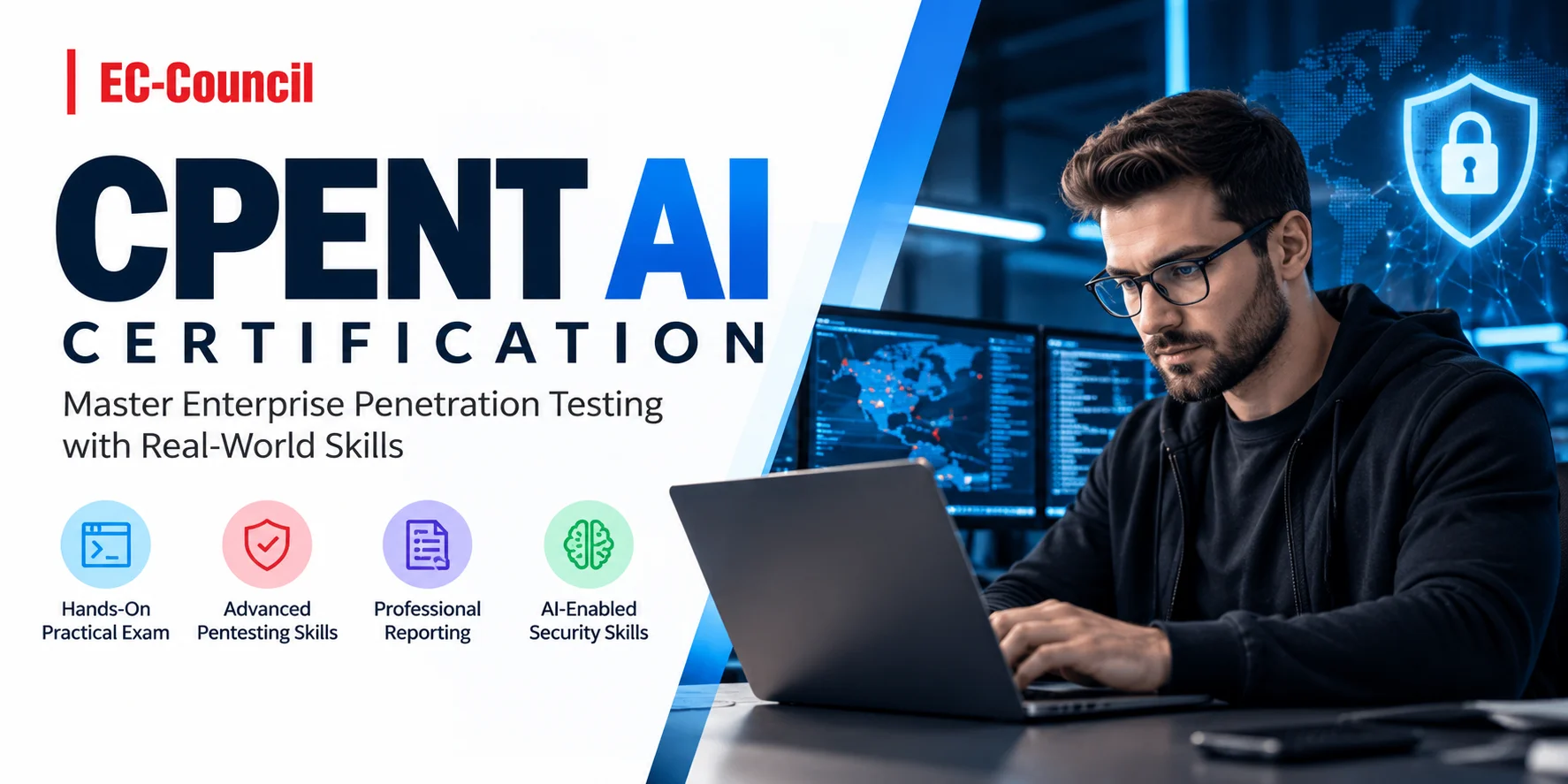
CPENT AI certification is EC-Council’s advanced, hands-on credential for professionals who want to prove enterprise penetration-testing skills. The program covers engagement planning, reconnaissance, web and API security, network defense evasion, Windows and Active Directory, Linux, binary exploitation, IoT, pivoting, and professional reporting. Its exam is 100% practical, remotely proctored, and available as one 24-hour session or two 12-hour sessions. Candidates submit a penetration-testing report within seven days. CPENT AI is suitable for experienced security practitioners, not beginners. The current cost depends on the selected delivery method, package, country, and training provider, and the features included, access period, taxes, and support.
What Is the CPENT AI Certification?
The Certified Penetration Testing Professional, commonly written as CPENT or CPENT AI, validates the ability to execute a complete penetration test in a changing enterprise environment. It is not a multiple-choice credential built around memorising tool names. Candidates investigate targets, exploit weaknesses, move through segmented networks, manage time, and communicate business impact.
The official EC-Council CPENT AI program page describes live ranges, 110+ labs, 50+ tools, CTF challenges, and five multidisciplinary ranges. AI supports repetitive work and analysis; it does not replace authorisation, manual validation, or security judgement.
This makes CPENT a serious air penetration testing certification for professionals combining methodology, scripting, exploitation, evasion, and reporting.
Who Should Pursue CPENT AI Certification?
CPENT AI Certification is for people who understand cybersecurity fundamentals and want to advance into offensive security:
- Penetration testers and red team operators: Professionals seeking deeper practice with complex networks, pivoting, exploitation, and realistic attack paths.
- VAPT analysts and engineers: Security professionals connecting vulnerability findings with exploitation and business risk.
- Application and network security engineers: Specialists expanding into web, API, infrastructure, Active Directory, and hybrid environments.
- Security consultants and leads: Practitioners responsible for scope, evidence, client communication, and remediation.
EC-Council allows entry through an information-security background, CEH, or equivalent knowledge. Direct exam candidates need at least two years of information-security experience. Since CPENT is not for beginners, candidates should understand networking, operating systems, scripting, Linux, Windows, and web applications.
|
CPENT AI Exam Detail |
Information |
|
Exam Type |
100% practical, remotely proctored assessment |
|
Exam Session Option 1 |
One continuous 24-hour session |
|
Exam Session Option 2 |
Two separate 12-hour sessions |
|
Report Submission |
Penetration-testing report must be submitted within 7 days after the final exam session |
|
Report Focus |
Candidates document scope, evidence, impact, risk, and remediation |
|
Training Duration |
EC-Council lists 40 hours of CPENT training |
|
Training Options |
Self-study, live online, or in-person |
|
Passing Score |
Cut score can vary depending on exam difficulty |
|
Cut Score Range |
Approximately 60%–85%, depending on the exam form |
|
CPENT Credential |
A score at or above the applicable cut score, up to 89%, can earn the CPENT credential |
|
CPENT + LPT |
A score of 90% or higher can qualify candidates for CPENT and the Licensed Penetration Tester (LPT) credential |
|
Fixed Passing Score? |
No universal fixed passing percentage should be claimed because the cut score can vary by exam form |
CPENT AI vs OSCP: Skills and Exam Focus
CPENT AI and OSCP+ are both practical penetration-testing certifications, but they assess different ranges of skills. The CPENT AI exam format and reporting details are listed in the table above.
- CPENT AI: Covers broad, multidisciplinary testing areas such as enterprise networks, web and API security, Active Directory, IoT/OT, binary exploitation, and pivoting.
- OSCP+: Tests exploitation and privilege escalation across three standalone machines and an Active Directory set of three machines.
- Exam rules: OSCP+ prohibits AI chatbots and restricts Metasploit to one chosen target. For CPENT AI, check EC-Council’s current exam instructions for tool and AI-use rules.
Think about the skills and environment you want to demonstrate when choosing between them.
CPENT vs CEH AI Features: Key Technical Differences
CEH and CPENT serve different points in a cybersecurity career. EC-Council describes CEH as a core ethical-hacking credential, while CPENT tests advanced practical skills across a connected enterprise environment.
- Learning objective: CEH covers ethical-hacking concepts and tools; CPENT tests an end-to-end penetration test.
- Assessment style: CEH is knowledge-focused; CPENT tests exploitation, movement, decisions, and reporting.
- Environment: CPENT uses layered ranges with networks, applications, defenses, and hidden segments.
- Technical depth: CPENT adds Active Directory, Linux escalation, binaries, IoT, OT, scripting, evasion, and pivoting.
- Career level: CEH supports entry and intermediate paths; CPENT suits experienced testers and offensive-security consultants.
Choose based on readiness. Beginners need foundations; working testers may benefit from CPENT because its structure reflects a real engagement.
CPENT AI Practical Exam: What Is Known About the Tools
EC-Council describes the CPENT AI program as providing more than 50 penetration-testing tools. Its public materials do not publish a fixed list of tools used in every practical exam. The tools named in course materials are examples for training, not a guaranteed exam inventory.
EC-Council course materials name tools and frameworks including the Social-Engineer Toolkit (SET), Binwalk, Capstone Framework, and Metasploit Framework. Candidates should prepare for the relevant testing skills, but should not assume that each named tool will be available or required in the exam.
CPENT Certification Cost and Syllabus Breakdown
CPENT Certification Cost and Price Factors
There is no single global CPENT price. The CPENT certification cost can change according to delivery model, country, taxes, courseware, lab access, voucher, support, and retake terms. Review every package inclusion.
At the time of review, EC-Council’s store lists CPENT Exam + Range at $999, including a 90-day practice range and live exam. CPENT Retake Exam is listed at $499 and includes the voucher only. These are not universal prices or complete instructor-led packages. Final CPENT AI cost may vary with delivery method, taxes, training, or support. Confirm inclusions and retake rules before payment.
CPENT AI Syllabus: Core Areas
The CPENT syllabus follows the work performed during a professional engagement:
- Engagement planning and ethics: Scope, objectives, rules of engagement, communication, and legal limits.
- Reconnaissance: OSINT, attack-surface mapping, enumeration, and intelligence analysis.
- Social engineering: Human-focused testing methods and controls.
- Web and API security: Authentication flaws, SQL injection, XSS, JWT, endpoints, and misconfigurations.
- Network and perimeter security: Firewalls, IDS, access, pivoting, and movement to critical assets.
- Windows and Active Directory: Enumeration, privilege escalation, password attacks, and lateral movement.
- Linux exploitation: Initial access, enumeration, misconfiguration review, and privilege escalation.
- Reverse engineering and binaries: Static and dynamic analysis, fuzzing, buffer overflows, and exploit development.
- IoT and OT testing: Firmware, device interfaces, protocols, and industrial-control security.
- Reporting and post-testing actions: Evidence, findings, risk, remediation, retesting, and report handling.
How to Pass CPENT Exam: Proven Preparation Strategy
CPENT exam preparation should focus on repeatable execution rather than random tool practice:
- Strengthen the base: Review TCP/IP, routing, DNS, HTTP, Linux, Windows, Active Directory, and scripting.
- Practise complete engagements: Move from authorisation and scope through reconnaissance, exploitation, evidence, and remediation.
- Train on segmented networks: Learn routes, tunnels, filtering rules, proxies, and trust relationships. Pivoting is a reasoning problem.
- Write while testing: Keep timestamps, commands, screenshots, affected assets, proof of impact, and remediation notes.
- Use AI only if EC-Council’s current exam rules permit it. Never paste sensitive client data into an unapproved service.
- Run timed simulations: Include breaks, evidence capture, and reporting in long practice blocks.
- Build a personal CPENT cheatsheet: Record reliable commands, pivoting syntax, report headings, troubleshooting checks, and decision points.
A useful CPENT exam review examines methodology as well as technical wins: scope, evidence, business risk, and realistic remediation.
Why Choose Penetration Testing Training at NYTCC?
Structured training helps when the main gap is execution. A focused CPENT training course should provide guided labs, feedback, and a report plan. If you choose NYTCC or another private provider, confirm exactly what the package includes:
- Hands-on practice: Enterprise scenarios involving web applications, networks, Active Directory, binaries, IoT, and pivoting.
- Instructor guidance: Help with enumeration, privilege escalation, exploit development, and evidence quality.
- Exam preparation: Lab targets, mock assessments, timed simulations, and revision checkpoints.
- Reporting discipline: Turn technical activity into findings, impact, and remediation.
Training value should be measured by practice quality and feedback, not promises of guaranteed questions or claims that a provider represents EC-Council unless that relationship is clearly stated.
Is CPENT AI Certification Worth It?
CPENT can be worth the investment for professionals targeting penetration testing, red teaming, VAPT, or offensive security. Its benefit is breadth: planning, reconnaissance, exploitation, evasion, movement, scripting, and reporting.
It may not suit someone still learning networking, Linux, web security, or basic ethical hacking. A foundational course may be better first. Employers also assess experience, communication, scripting, and project results; certification alone does not create expertise.
CPENT AI Certification FAQs
What does CPENT stand for?
CPENT stands for Certified Penetration Testing Professional. It is an EC-Council credential for advanced, practical penetration-testing skills.
Is CPENT an AI pentest certification?
Yes. The CPENT AI program maps AI techniques to penetration-testing phases while requiring manual validation, ethical boundaries, and professional reporting.
How long is the CPENT exam?
It is either one 24-hour session or two 12-hour sessions. The report is due within seven days of the final session.
What is the CPENT exam price?
The price depends on the package and location. Listings change, and provider packages may include different combinations of labs, courseware, vouchers, support, and retakes.
Is CPENT suitable for beginners?
No. CPENT is intended for candidates with an information-security background or equivalent knowledge. Direct exam candidates should have at least two years of experience.
What is the CPENT review in one sentence?
CPENT is a demanding practical credential for experienced professionals who want to prove broad enterprise penetration-testing ability, including AI-assisted workflows.
Ready to Start Your CPENT AI Certification Journey?
Contact our team for EC-Council CPENT AI certification online training, study resources, practice questions, and exam preparation support.
Contact UsNext Steps to Elevate Your Offensive Security Career
Start with an honest skills audit. If you can enumerate, exploit, pivot, script, document, and explain risk under time pressure, CPENT may be the right next step. If one area is weak, fix it before buying a voucher. Choose CPENT preparation with live practice, report feedback, and timed execution, then verify the latest requirements and package terms before enrollment. Enterprise security is mastered through disciplined practice; the certification should be evidence of that work, not a substitute for it.