
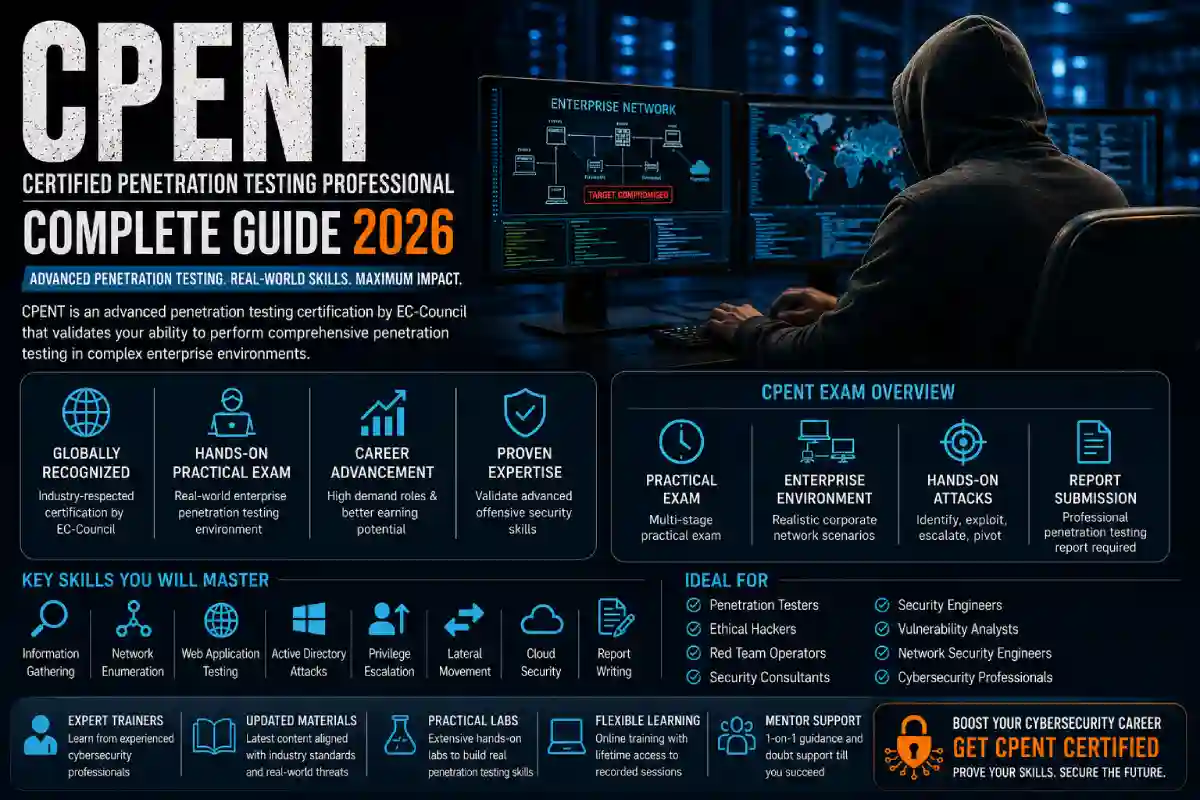
As cyber threats become more advanced, organizations require security professionals who can identify and exploit vulnerabilities before attackers do. The Certified Penetration Testing Professional (CPENT) certification is one of the most advanced penetration testing credentials available today. Offered by EC-Council, CPENT is designed to prepare cybersecurity professionals for real-world penetration testing across modern enterprise environments.
Unlike many traditional certifications, CPENT focuses on hands-on practical assessments that simulate real attack scenarios, helping professionals develop the skills needed to secure networks, web applications, cloud environments, and enterprise infrastructures.
Whether you are an ethical hacker, penetration tester, or cybersecurity consultant, CPENT can significantly enhance your technical expertise and career opportunities.
What is CPENT Certification?
Certified Penetration Testing Professional (CPENT) is an advanced cybersecurity certification developed by EC-Council. It validates a professional's ability to conduct enterprise-level penetration testing by identifying vulnerabilities, exploiting systems, bypassing security controls, and providing remediation recommendations.
The certification emphasizes practical penetration testing skills across complex enterprise networks rather than relying solely on theoretical knowledge.
Why Choose CPENT?
CPENT has become a preferred certification for professionals pursuing offensive cybersecurity careers because it emphasizes real-world attack simulations.
Key Benefits
- Globally recognized EC-Council certification
- Hands-on practical penetration testing exam
- Enterprise network attack simulations
- Advanced exploitation techniques
- Increased career opportunities
- Higher earning potential
- Industry-recognized offensive security skills
Who Should Pursue CPENT?
CPENT is ideal for professionals such as:
- Penetration Testers
- Ethical Hackers
- Red Team Operators
- Cybersecurity Engineers
- Security Consultants
- Network Security Engineers
- Vulnerability Assessment Specialists
- SOC Analysts
- Incident Response Professionals
- Experienced IT Professionals
Recommended Prerequisites
Although there are no mandatory prerequisites, candidates should have knowledge of:
- Networking Fundamentals
- TCP/IP Protocols
- Linux Administration
- Windows Administration
- Ethical Hacking Concepts
- Web Application Security
- Python or Bash Scripting
- Active Directory Fundamentals
- Vulnerability Assessment
Professionals holding CEH or equivalent practical experience often transition successfully into CPENT.
CPENT Training Overview
The CPENT training program prepares candidates for enterprise-level penetration testing using realistic attack scenarios.
Major Topics Covered
- Information Gathering
- Network Enumeration
- Web Application Penetration Testing
- Active Directory Security
- Exploitation Techniques
- Wireless Network Security
- Privilege Escalation
- Persistence Techniques
- Lateral Movement
- Pivoting
- Cloud Security Testing
- IoT Penetration Testing
- Binary Exploitation
- Report Writing
CPENT Exam Overview
| Feature | Details |
|---|---|
| Certification Body | EC-Council |
| Certification | Certified Penetration Testing Professional (CPENT) |
| Exam Type | Practical Lab Examination |
| Duration | Multi-stage Practical Exam |
| Assessment | Enterprise Network Penetration Testing |
| Report Submission | Required |
The CPENT exam evaluates candidates in a realistic enterprise environment where they must demonstrate their ability to discover vulnerabilities, exploit systems, move laterally, escalate privileges, and prepare a professional penetration testing report.
Skills You'll Gain
Preparing for CPENT helps develop advanced penetration testing skills, including:
- Network Scanning
- Enumeration
- Vulnerability Analysis
- Web Application Testing
- Active Directory Exploitation
- Privilege Escalation
- Lateral Movement
- Pivoting
- Password Attacks
- Exploit Development Basics
- Wireless Security Testing
- Cloud Penetration Testing
- Report Writing
- Enterprise Security Assessment
Career Opportunities After CPENT
CPENT certification prepares professionals for advanced offensive security roles such as:
- Penetration Tester
- Senior Ethical Hacker
- Red Team Specialist
- Security Consultant
- Application Security Engineer
- Cybersecurity Engineer
- Network Security Consultant
- Threat Hunter
- Security Researcher
- Vulnerability Assessment Specialist
Salary Prospects
CPENT-certified professionals are in high demand across industries including finance, healthcare, government, telecommunications, cloud computing, and cybersecurity consulting.
Salary depends on experience, technical expertise, employer, and geographic location. Professionals with practical penetration testing skills typically earn competitive compensation packages.
How to Prepare for CPENT
To maximize your chances of success:
- Study the official EC-Council CPENT curriculum.
- Practice extensively in penetration testing labs.
- Learn Linux and Windows administration.
- Master Active Directory attacks.
- Improve scripting skills.
- Practice enterprise network exploitation.
- Solve Capture the Flag (CTF) challenges.
- Learn professional report writing.
- Take mock practical exams.
Hands-on practice is the key to success in CPENT.
Why Choose NYTCC for CPENT Preparation?
NYTCC provides comprehensive CPENT preparation designed to help professionals succeed in today's competitive cybersecurity industry.
What You'll Receive
- Expert Cybersecurity Trainers
- Updated Study Materials
- Practical Lab Exercises
- Mock Penetration Testing Scenarios
- One-on-One Mentoring
- Flexible Learning Options
- Exam Preparation Support
- Personalized Guidance
Frequently Asked Questions
Is CPENT difficult?
Yes. CPENT is considered an advanced practical certification that evaluates enterprise-level penetration testing skills rather than theoretical knowledge.
Can beginners take CPENT?
CPENT is best suited for professionals who already possess foundational networking and cybersecurity knowledge. Beginners should first gain experience with cybersecurity fundamentals before attempting CPENT.
Is CPENT worth it?
Absolutely. CPENT is highly respected by employers seeking professionals with practical enterprise penetration testing expertise and advanced offensive security skills.
How long does CPENT preparation take?
Preparation time varies depending on prior experience. Most candidates spend several months studying, practicing in labs, and improving their practical penetration testing skills.
Why CPENT Is in High Demand
As organizations continue adopting cloud computing, hybrid infrastructures, and digital transformation initiatives, cyber threats have become increasingly sophisticated. Businesses need professionals capable of performing advanced penetration testing against enterprise environments.
CPENT-certified professionals possess practical skills that enable them to identify vulnerabilities, simulate real-world attacks, and strengthen organizational security. This makes them valuable assets across industries including banking, healthcare, government, defense, technology, telecommunications, and consulting.
Conclusion
The Certified Penetration Testing Professional (CPENT) certification is one of the most advanced credentials for cybersecurity professionals pursuing careers in offensive security. Its practical, hands-on approach equips candidates with the skills needed to perform enterprise penetration testing, exploit modern infrastructures, and deliver professional security assessments.
Whether your goal is to become a penetration tester, ethical hacker, security consultant, or red team specialist, CPENT can significantly enhance your technical capabilities and career prospects. With expert guidance, practical labs, updated study materials, and personalized mentoring from NYTCC, you can prepare confidently and take the next step toward a successful cybersecurity career.