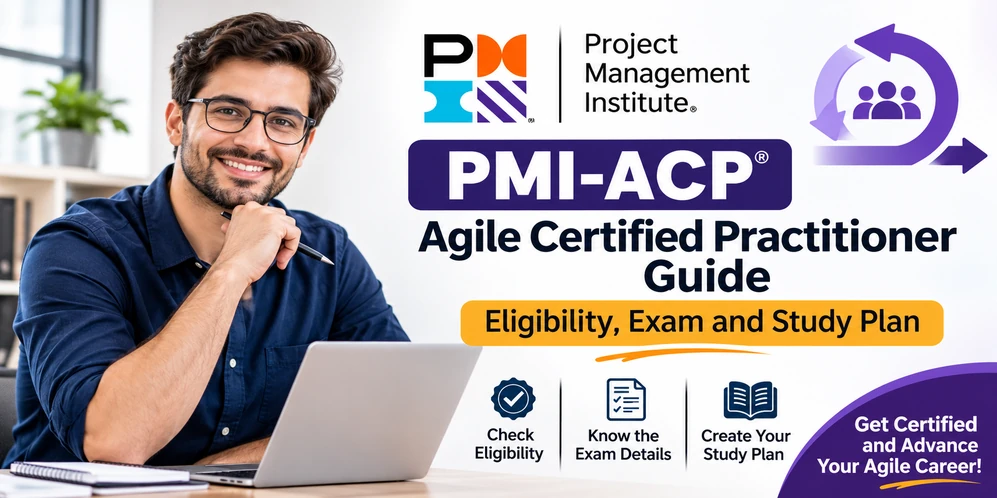
The PMI-ACP Agile Certified Practitioner credential is for professionals who use agile practices at work and want to demonstrate experience across more than one framework. This guide explains what the certification covers, who can apply, how the exam works, and how to prepare using PMI’s current requirements.
The certification is framework-agnostic. It covers agile principles and practices used in approaches such as Scrum, Kanban, and Lean, with an emphasis on adapting work to deliver value. PMI identifies product owners, Scrum masters, agile team leads, developers, project managers, agile coaches, and product managers among the roles that may benefit.
What is the PMI-ACP certification?
PMI-ACP stands for PMI Agile Certified Practitioner. It is a professional certification from the Project Management Institute that assesses an individual’s ability to apply agile concepts and practices. Rather than focusing on only one framework, it tests knowledge across four domains: Mindset, Leadership, Product, and Delivery.
The PMI-ACP certification guide is especially relevant to people who work on agile teams or help teams plan, prioritize, coordinate, and improve their work. It can also help project managers who need to lead projects in organizations that use adaptive delivery methods.
The credential does not replace hands-on experience. Its strongest use is as evidence of agile knowledge alongside examples of how you have applied that knowledge: facilitating collaboration, responding to feedback, managing priorities, or improving delivery.
Who should consider the PMI-ACP?
The certification may suit you if your role involves agile work and you want a broader understanding of agile approaches. PMI lists roles including product owner, Scrum master, agile team lead, developer, project manager, agile coach, and product manager.
It may be less useful as an immediate first step if you have little or no agile experience. PMI’s eligibility criteria require relevant professional experience, so first confirm that your work history meets one of its accepted paths. The credential is also more useful when you can connect the exam concepts to real examples from projects or product work.
What are the PMI-ACP certification requirements?
PMI’s current requirements include an educational background, formal agile training, and qualifying agile experience. Before submitting an application, check the latest Exam Content Outline and make sure you can document each requirement.
| Requirement | Current PMI criteria |
|---|---|
| Education | High school diploma, GED, or global equivalent |
| Agile training | 21 hours of formal training in agile practices, frameworks, and methodologies |
| Agile experience | One of PMI’s accepted experience paths |
For agile experience, PMI lists these paths:
- Two years of agile experience within the past five years.
- One year of agile experience plus a degree from a Global Accreditation Center (GAC) program.
- One year of agile experience plus an eligible third-party agile certification that is current and was earned more than one year ago.
- An active PMP certification.
PMI’s Exam Content Outline says the 21 training hours must be completed before you submit your application. The training should align with agile topics in the outline, and you should keep proof of course completion. Review the current eligibility details before applying, especially if you plan to use a degree, another agile certification, or a PMP credential to meet the experience criteria.
How does the PMI-ACP application process work?
Start by checking that you meet the education, training, and experience requirements. Collect the information you need to describe your agile experience and record your formal training hours. Submit the application through PMI and wait for it to be accepted before paying the exam fee and scheduling the exam.
Use accurate, consistent information in your application. Keep course completion records and details of your work experience available in case you need to clarify your submission. Once accepted, choose an exam appointment that leaves enough time for a focused study period and any required scheduling arrangements.
What is on the PMI-ACP exam?
The PMI-ACP exam has 120 items and a time limit of three hours. PMI’s current outline describes multiple-choice, multiple-response, drag-and-drop-style items, and exhibits. Of the 120 items, 100 are scored and 20 are unscored pretest items. The unscored items are mixed into the exam and are not identified.
The exam includes a 10-minute break after you complete and review the first 60 items. Once you begin that break, you cannot return to the first section. PMI offers the exam at a test center and through online proctoring. Check the current PMI and exam-provider instructions before choosing an option.
PMI-ACP exam domains
| Domain | Share of exam |
|---|---|
| Mindset | 28% |
| Leadership | 25% |
| Product | 19% |
| Delivery | 28% |
The Mindset domain covers applying agile values and principles, encouraging experimentation, and supporting continuous learning. Leadership focuses on how practitioners help teams collaborate, improve, and work through challenges. Product includes understanding and prioritizing value. Delivery concerns planning, flow, quality, and delivering outcomes.
The percentages help you allocate study time, but they are not a substitute for studying the tasks and enablers in PMI’s outline. Since Mindset and Delivery each account for 28% of the exam, give them substantial attention while still preparing for every domain.
How can you prepare for the PMI-ACP exam?
Begin with the current PMI-ACP Exam Content Outline. Use it to identify the tasks and concepts you already know, the ones you need to review, and the areas where you need practical examples. Build your preparation around those gaps rather than relying on a single book or practice test.
PMI lists preparation options that include its authorized exam-prep course, practice exams, Study Hall, and the Agile Practice Guide. Choose resources that match the current outline. Practice questions can help you spot weak areas, but review why each answer is appropriate and connect it to the underlying agile principle or practice.
A six-week PMI-ACP study plan can provide structure:
- Week 1: Review eligibility, the exam format, and the full content outline. Take a short diagnostic quiz.
- Weeks 2–3: Study Mindset and Leadership. Use scenario questions to practice selecting responses that support collaboration and improvement.
- Week 4: Focus on Product. Review value, prioritization, feedback, and how product decisions respond to changing needs.
- Week 5: Study Delivery and revisit weaker topics. Practice interpreting exhibits and applying concepts to realistic situations.
- Week 6: Complete timed practice, review mistakes, and prepare your exam-day setup.
Adjust the schedule to your available study time and prior experience. Consistent sessions are more useful than cramming. Keep a short error log with the topic, why your answer was incorrect, and what principle would guide a better decision.
For a related overview of the eligibility process, read our ACP certification eligibility guide. Return to this guide to continue with the exam structure and preparation plan.
Is the PMI-ACP certification worth it for project managers?
The PMI-ACP certification may be worth considering for project managers whose work involves agile teams, iterative planning, or changing priorities. It can help structure and validate knowledge across several approaches, rather than concentrating solely on one framework.
Its value depends on your work and goals. Consider whether your organization uses agile practices, whether you can apply the concepts in your current role, and whether the certification is recognized in the positions or projects you are pursuing. The credential alone does not guarantee a job, promotion, or specific career outcome. Treat it as one part of your professional profile, supported by experience and results.
How do you maintain the PMI-ACP credential?
PMI-ACP holders must earn 30 professional development units (PDUs) during each three-year certification cycle to maintain the credential. PMI recognizes activities such as learning, teaching, presenting, reading, volunteering, and content creation. Track eligible activities as you complete them, and review PMI’s current renewal guidance so you can plan ahead.
Frequently asked questions
How many questions are on the PMI-ACP exam?
The exam has 120 items. PMI identifies 100 as scored items and 20 as unscored pretest items. The pretest items are distributed through the exam and are not marked.
How long is the PMI-ACP exam?
You have three hours to complete the exam. PMI’s outline also specifies a 10-minute break after the first 60 items, once you have reviewed that section.
How many agile training hours are required?
PMI currently requires 21 hours of formal training in agile practices, frameworks, and methodologies. Complete the training before submitting your application and keep proof of completion.
How often must PMI-ACP holders renew?
PMI-ACP holders need 30 PDUs every three years to maintain the certification. Check PMI’s current renewal guidance for accepted activities and reporting steps.
Ready to Start Your ACP Certifications Journey?
Contact our team for ACP certifications online training, study resources, practice questions, and exam preparation support.
Contact Us
Choose your next step
Review your experience against PMI’s current eligibility paths, then compare your knowledge with the four exam domains. If you qualify, build a study plan around the official outline and use practice questions to identify gaps. For the latest requirements, preparation options, and application instructions, visit PMI’s PMI-ACP certification page.