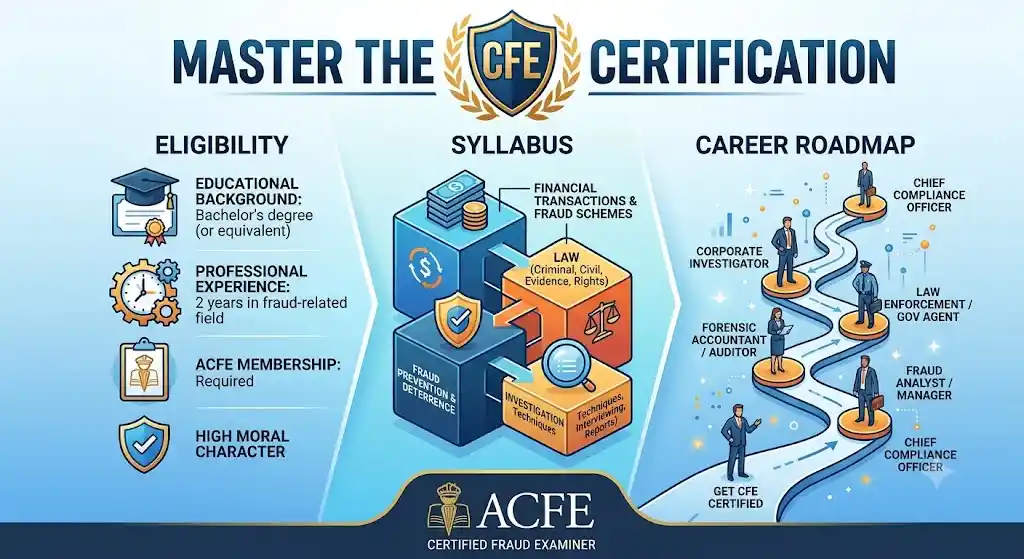
The CFE Certification (Certified Fraud Examiner) is a globally recognized credential awarded by the Association of Certified Fraud Examiners (ACFE). It validates elite expertise in fraud prevention, detection, and deterrence. To earn the CFE, candidates must meet a 40-point eligibility threshold based on education and professional experience, pass a rigorous four-part examination, and commit to strict ethical standards. This credential signals to employers that a professional possesses the advanced investigative, legal, and forensic accounting skills required to mitigate complex financial crimes.
Navigating the CFE Exam Eligibility Requirements
The ACFE utilizes a unique point system to determine candidate eligibility. To qualify to take the exam, you must accumulate a minimum of 40 qualifying points across three categories: education, professional affiliations, and professional experience. Furthermore, you must have a minimum of two years of professional experience in a fraud-related field to officially hold the credential.
Education: 10 points for each year of full-time collegiate study (e.g., a Bachelor’s degree yields 40 points).
Professional Experience: 5 points for each year of experience in a fraud-related profession (accounting, auditing, criminology, loss prevention, or law).
Other Certifications: 10 points for holding holding recognized professional credentials like a CPA, CIA, or CISA.
If you have a Bachelor's degree, you immediately meet the 40-point threshold to sit for the exam, but the credential itself will not be awarded until the two-year experience requirement is fulfilled.
CFE Exam Syllabus and Structure Breakdown
The CFE exam tests your capability to handle multifaceted fraud scenarios. The exam is administered via computer and consists of four distinct sections. Each section contains 100 multiple-choice and true/false questions, and candidates are given two hours per section.
Understanding the CFE exam syllabus and structure is critical for targeted preparation.
| Exam Section | Core Competencies Assessed | Focus Area Weighting |
|---|---|---|
| Financial Transactions & Fraud Schemes | Asset misappropriation, financial statement fraud, accounting concepts, and bribery. | Focuses heavily on basic accounting theory and the mechanics of financial crimes. |
| Law | Rules of evidence, criminal/civil justice systems, testifying as an expert witness, and individual rights. | Tests the legal frameworks required to conduct investigations without violating statutes. |
| Investigation | Interview theory, tracing illicit transactions, digital forensics, and report writing. | Emphasizes actionable, on-the-ground investigative techniques and data extraction. |
| Fraud Prevention & Deterrence | Corporate governance, white-collar crime theories, fraud risk assessment, and ethics. | Evaluates the psychological elements of fraud (the Fraud Triangle) and enterprise risk management. |
How to Become a Certified Fraud Examiner: Step-by-Step
Transitioning from an auditor or investigator to a recognized fraud expert requires a systematic approach. Here is how to become a Certified Fraud Examiner:
Join the ACFE: You must be an active member of the Association of Certified Fraud Examiners to apply for the credential.
Prepare Your Application: Submit proof of your education, a detailed resume showcasing fraud-related experience, and three professional letters of recommendation.
Pay the Examination Fee: The standard certification fee covers the cost of the exam administration.
Study the Prep Materials: Dedicate 60 to 90 days to rigorous study, focusing heavily on your weakest domains.
Pass All Four Sections: You must score at least 75% on each of the four exam sections. If you fail a section, you only need to retake that specific part.
Final Approval: Once you pass, the ACFE certification committee will review your application for final credential issuance.
Expected Certified Fraud Examiner Salary and Industry ROI
Investing time and capital into this credential yields substantial returns. Organizations actively prioritize candidates who can identify revenue leaks and enforce regulatory compliance.
According to industry benchmarking, the average Certified Fraud Examiner salary carries a 31% premium over non-certified peers in similar roles.
Entry-Level Fraud Analyst: $65,000 – $80,000 annually.
Mid-Level Forensic Accountant / Investigator: $90,000 – $115,000 annually.
Senior Fraud Risk Manager / Director of Compliance: $130,000 – $160,000+ annually.
Optimizing Your Prep: CFE Exam Study Material & Training
Because the exam covers four vastly different disciplines—accounting, law, investigation, and criminology—relying on your existing professional background is rarely enough. An auditor may ace the financial section but fail the legal domain without proper preparation.
Selecting the right CFE exam study material is the highest-leverage decision you can make. The standard ACFE Fraud Examiners Manual is exhaustive, spanning over 2,000 pages. To streamline preparation, candidates should heavily utilize diagnostic practice exams that mimic the testing environment.
For professionals seeking structured guidance, enrolling in comprehensive CFE exam online training accelerates readiness by distilling complex legal and financial jargon into practical applications. High-quality instruction bridges the gap between theory and examination reality.
To secure your credential with expert-led support, explore dedicated training pathways like the CFE Certification program in New York offered by NYTCC. Map your study timeline today, book your exam window, and transition your career into the high-demand field of elite anti-fraud operations.