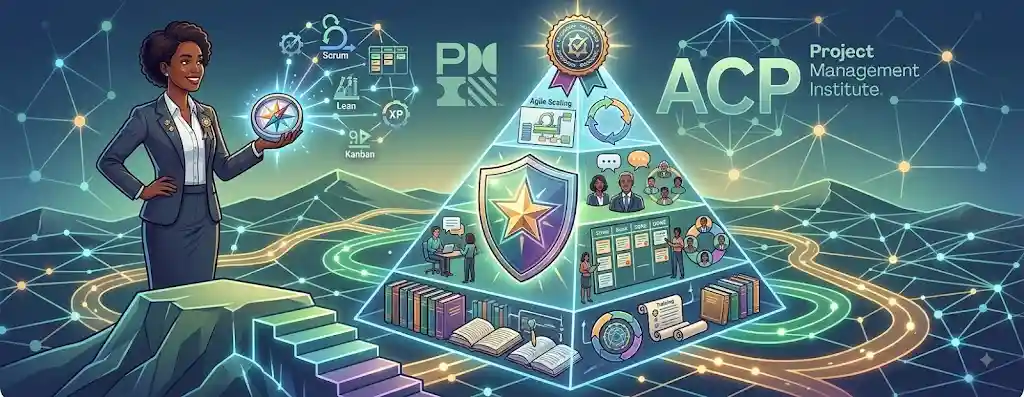
The ACP Certification (PMI-ACP®), issued by the Project Management Institute, is a globally recognized credential validating expertise across multiple Agile methodologies, including Scrum, Kanban, Lean, and Extreme Programming (XP). To earn the PMI-ACP, candidates must meet specific project experience prerequisites, complete 21 contact hours of Agile training, and pass a 120-question situational examination. The certification proves a practitioner's ability to drive adaptive planning, value-driven delivery, and team collaboration in high-velocity tech and corporate project environments.
Why the ACP Certification Outperforms Framework-Specific Credentials
Single-framework certifications like Certified ScrumMaster (CSM) or Professional Scrum Master (PSM) focus primarily on the mechanics of Scrum. However, modern corporate environments rarely operate on a single framework. Organizations regularly combine Scrum for sprint cadence, Kanban for flow control, and Extreme Programming (XP) practices for continuous code integration.
Earning the ACP Certification signals that you understand the overarching Agile mindset and can select, mix, and tailor frameworks based on specific team needs and organizational dynamics. This framework-agnostic capability makes PMI-ACP credential holders versatile leaders capable of steering complex digital transformations.
PMI ACP Eligibility Requirements
PMI sets strict standards to verify that candidates possess practical Agile field experience before taking the exam. Reviewing the PMI ACP eligibility requirements ensures your application moves smoothly through PMI's audit process:
Educational Attainment: High school diploma, associate degree, or global equivalent.
General Project Management Experience: Minimum 2,000 hours (12 months) working on project teams within the last 5 years. (Note: Active PMP® or PgMP® credential holders automatically satisfy this requirement).
Agile Project Experience: Minimum 1,500 hours (8 months) working explicitly on Agile project teams or applying Agile methodologies within the last 3 years. These hours must be distinct from general project management hours.
Agile Training: 21 contact hours earned through formal education in Agile practices, tools, and philosophy.
PMI ACP Exam Cost and Fees
Planning your certification investment involves factoring in application fees, membership options, and maintenance costs over the 3-year credential cycle.
The table below provides a complete overview of the PMI ACP exam cost and fees:
| Expense Category | PMI Active Member | Non-Member Rate |
|---|---|---|
| Initial Exam Fee | $435 | $495 |
| Re-examination Fee | $335 | $395 |
| Annual PMI Membership | $139 (+$10 joining fee) | N/A |
| Credential Renewal Fee (3 Years) | $60 | $150 |
Strategic Tip: Joining PMI prior to paying for the exam saves $60 on the examination itself while providing immediate access to digital downloads of the PMI Agile Practice Guide and local chapter networking.
PMI ACP Syllabus and Domain Breakdown
The PMI ACP syllabus and domain breakdown tests decision-making across seven core performance domains. Rather than testing simple terminology, questions assess how you apply Agile principles in complex situational scenarios.
Agile Principles and Mindset (16%): Evaluates your ability to foster an environment of trust, transparency, continuous feedback, and servant leadership.
Value-Driven Delivery (20%): Assesses prioritization strategies, business value realization, risk management, and incremental product releases.
Stakeholder Engagement (17%): Measures cross-functional communication, active listening, expectation management, and collaborative decision-making.
Team Performance (16%): Tests team formation, self-organization, cross-functional collaboration, performance metrics, and velocity tracking.
Adaptive Planning (12%): Covers timeboxing, progressive elaboration, story point estimation (e.g., Fibonacci, Planning Poker), and iteration planning.
Problem Detection and Resolution (10%): Focuses on identifying impediments, tracking process bottlenecks, root-cause analysis, and continuous risk reduction.
Continuous Improvement (9%): Tests retrospective facilitation, process optimization, value stream mapping, and personal development.
Official standards and domain definitions are maintained directly by the Project Management Institute.
PMI ACP Exam Format and Question Types
Understanding the PMI ACP exam format and question types helps you manage time efficiently during test day:
Total Questions: 120 multiple-choice questions (100 scored items and 20 unscored pretest items distributed randomly).
Time Allowed: 180 minutes (3 hours) with no mandatory breaks.
Testing Options: Computer-based testing at Pearson VUE testing centers or remotely via online proctored exams.
Pacing Target: Approximately 90 seconds per question.
Question Characteristics
Situational Scenarios (80%+): Questions describe a project challenge—such as scope creep mid-sprint, team conflict, or shifting stakeholder priorities—and require choosing the best Agile resolution.
Methodology Application: Scenarios testing when to deploy specific practices from Scrum, Kanban, Lean, or Extreme Programming.
Metrics and Tracking: Interpreting velocity charts, burndown/burnup graphs, lead time, cycle time, and Work-In-Progress (WIP) limits.
How to Become an Agile Certified Practitioner: Step-by-Step
Executing a clear progression plan ensures your application passes verification and prepares you for first-time exam success. Follow these five steps when planning how to become an Agile Certified Practitioner:
Secure Your 21 Contact Hours: Enroll in an accredited course that covers multi-framework Agile methodologies. If you prefer structured, local classroom instruction, consider enrolling in specialized ACP Certification training in New York.
Document Your Project Hours: Log your 2,000 general project hours and 1,500 Agile project hours accurately, recording supervisor contact details in case of a PMI audit.
Submit the Application: Complete the online application on the PMI portal. PMI takes 5 to 10 business days to review submissions.
Schedule Your Test Date: Upon approval, pay the exam fee and schedule your test window with Pearson VUE.
Run Exam Simulations: Complete full-length practice tests to condition your pacing and refine your situational judgment.
PMI Agile Certified Practitioner Salary and Career Outlook
Earning the PMI-ACP credential unlocks upper-tier project leadership roles across software development, finance, healthcare, and engineering sectors.
Industry data shows that the average PMI Agile Certified Practitioner salary ranges between $118,000 and $148,000 annually in major commercial markets, with senior leads commanding higher compensation packages.
Typical Positions Held by PMI-ACP Holders
Agile Project Manager: $115,000 – $138,000/year
Scrum Master / Agile Delivery Lead: $120,000 – $145,000/year
Agile Coach: $135,000 – $165,000/year
Technical Program Manager (TPM): $140,000 – $170,000/year
Prep Strategy and Working with PMI ACP Practice Exam Questions
Because the exam heavily emphasizes situational judgment over simple memorization, reading book chapters alone is insufficient.
Apply Servant Leadership Thinking: When answering situational questions, default to choices that empower the self-organizing team, promote customer collaboration, and eliminate impediments rather than imposing command-and-control decisions.
Study the PMI Agile Practice Guide: Internalize core terminology, release planning dynamics, and hybrid framework applications.
Practice Under Realistic Conditions: Work through sets of PMI ACP practice exam questions in timed blocks to build mental stamina for the 3-hour exam window. Focus on understanding the rationales behind incorrect distractors as well as correct options.
Immediate Next Steps
Audit your past project timeline to confirm your 1,500 Agile experience hours, secure your 21 contact hours through a structured training program, and establish a firm 60-day target date to register for your exam.